
Guide · AI agents
What is MCP (Model Context Protocol) and what is it for in a company
MCP (Model Context Protocol) is an open standard for connecting AI applications to tools and data sources in a uniform way: an assistant or agent can use your CRM, your files or your database through an "MCP server" without custom integrations for every combination. It brings order and reuse, but requires well-defined permissions and security.
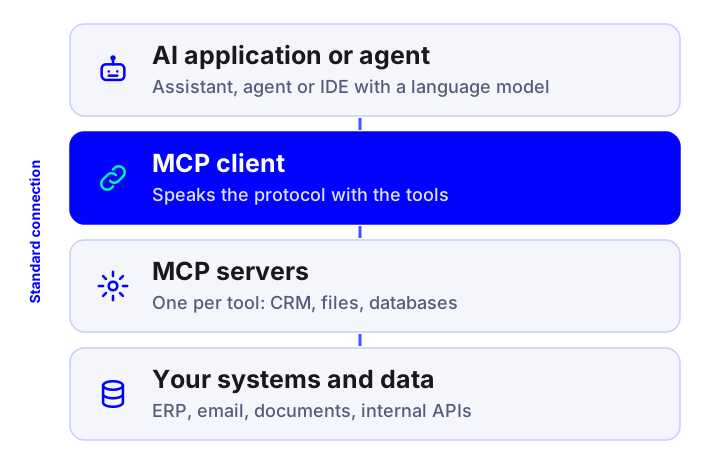
What problem MCP solves
For an AI agent to do something useful it needs tools: query an order, search a document, create a task. Until now every AI application integrated each tool in its own way, and every change meant redoing the work. The Model Context Protocol is an open standard, initially driven by Anthropic and later adopted by other players, that defines how an AI application discovers and uses external tools and data.
The idea is that of a "universal connector": if your tool exposes an MCP server, any compatible application can use it, and if you change model or application, your connectors are still valid.
How it works
- MCP server: a small service that exposes tools (actions), resources (data) and instruction templates of a specific system, with its permissions.
- MCP client: the AI application (an assistant, an agent, a code editor) that connects to one or more servers.
- Discovery: the client asks which tools are available and the model decides when to use them.
- Controlled execution: each call goes through the server's rules (permissions, validation, logging) and, where appropriate, through a person's approval.
Business use cases
Agents connected to your systems
An agent that queries the CRM, the ERP and email through MCP servers with their own permissions.
AI agents →Access to internal knowledge
Servers that give the assistant access to documentation, wikis and repositories.
RAG assistant →Tools for the technical team
Code editors and development assistants connected to tickets, repositories and test databases.
A common layer for several models
The same tools available to different models and applications, without duplicated integrations.
AI integration →MCP, API and automation: how they differ
| API | Automation (n8n, etc.) | MCP | |
|---|---|---|---|
| What it is for | Communication between systems | Flows with fixed rules | Letting a model discover and use tools |
| Who decides the step | The programmer | The designed flow | The model, within the server's limits |
| Common standard | Every API is different | Every platform is different | A common protocol |
It does not replace APIs: an MCP server usually wraps an existing API. And it coexists with n8n: predictable flows are automated and MCP gives the agent access to tools for the unpredictable.
Security: what to take care of
- Minimum permissions: each server exposes only the necessary actions and, when enough, read-only.
- Human approval for critical or irreversible actions.
- Prompt injection: the content the agent reads (an email, a web page) may contain malicious instructions; what triggers actions must be isolated and validated.
- Third-party servers: install only trusted servers and review what data they receive.
- Authentication and logging: per-user credentials, not shared, and traceability of every call.
- Compliance: data passing through the server remains subject to GDPR; see AI, GDPR and the AI Act.
When it makes sense to adopt MCP
If you have several agents or assistants that must use the same tools, if you want to avoid duplicated integrations or if you work with AI development tools, MCP brings order. If you only need one specific automation, an API and a flow are enough. We evaluate it in the AI diagnostic and implement it with our AI agents and AI integration services.
Frequently asked questions
What is MCP in artificial intelligence?
MCP (Model Context Protocol) is an open standard that defines how an AI application connects to external tools and data sources, so an agent can use your systems in a uniform way.
Who created the Model Context Protocol?
It was initially driven by Anthropic as an open standard and has been adopted by other providers and tools.
Does MCP replace APIs?
No. An MCP server normally wraps an existing API and exposes it in a standard way to language models.
Is it safe to use MCP in a company?
It can be, with minimum permissions, human approval for critical actions, trusted servers, per-user authentication and logging of every call, and protection against prompt injection.
Do I need MCP to build an AI agent?
It is not essential. It is useful when several agents or applications share tools; for a specific case it is enough to integrate the APIs directly.
Shall we talk about your project?
Tell us about your case and we will reply within 24-48 hours with a proposed scope and an indicative quote.
Tell us about your project
Describe what you want to achieve and which systems you work with. We reply within 24-48 hours.
Artificial intelligence services and guides
Everything we do with AI for business, from the diagnostic to the product in production. Artificial intelligence for business.
Services
- AI agents for businessSystems that plan and carry out tasks on your CRM, ERP and email.
- Custom AI chatbots24/7 support and sales on web and WhatsApp, connected to your systems.
- Assistant over your company documents (RAG)An AI that answers with your information and cites the source.
- AI integration in apps and softwareAdd language models to your product without rebuilding it.
- Artificial intelligence consultingDiagnostic, prioritised cases and a roadmap with return.
- Machine learning and predictive analyticsDemand forecasting, churn, anomalies and predictive maintenance.
- Computer vision and OCR with AIReading invoices and delivery notes and image-based quality inspection.
- Custom AI app developmentApps and platforms with AI built in from the design stage.
- Process automation with AIWorkflows that save hours of manual work.
- AI voice assistantsPhone agents that answer calls and book appointments using your systems.
- AI recommendation systemsPersonalisation and recommendations measured with A/B tests.
Guides
- AI agent, chatbot or assistant: differences
- How much an AI chatbot or agent costs
- What RAG is and how to use it in your company
- AI use cases in business by department
- How to implement AI in a small business
- n8n, Make, Zapier or custom development
- How to choose the AI model for your company
- AI, GDPR and the AI Act: what to review
- How to measure the ROI of an AI project
- How to appear in ChatGPT and AI Overviews
- Automation with n8n for business
- 17 tools to develop apps with AI
- Mobile apps with artificial intelligence
- 10 AI automations for small businesses
- WhatsApp Business with AI: customer service
- AI in mobile apps: device or cloud
AI by sector
- AI for e-commerce
- AI for real estate
- AI for clinics and healthcare
- AI for logistics and transport
- AI for human resources
- AI for insurance and brokerage
- AI for industry and manufacturing
- AI for hospitality and restaurants
- AI for law and accounting firms
- AI for education and e-learning