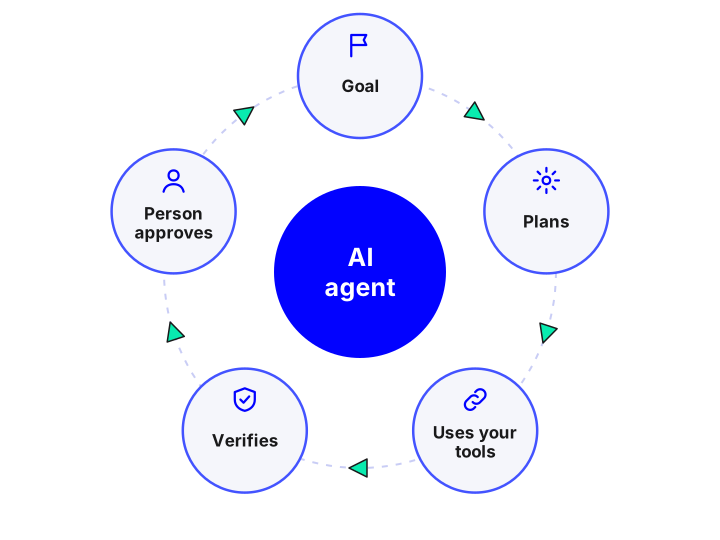
An AI agent is a system that receives a goal, decides the steps, uses your tools (CRM, ERP, email, databases) and delivers the finished work, with human oversight where it matters. At App Design we design, build and put into production custom agents for high-volume, high-cost processes.
By Oliver Guirado · Updated on October 28, 2026 · 8 min read
What an AI agent is and how it differs from a chatbot
An AI agent combines a language model with tools and business rules. It does not just converse: it reads an email, queries the ERP, drafts a quote, updates the CRM and alerts a person when something is out of the ordinary.
The practical difference from a chatbot is bounded autonomy: a chatbot answers; an agent acts within limits that we define with you (which systems it can touch, which amounts it can approve, when it must ask). For the full comparison, read AI agent, chatbot or assistant: the differences.
Agents work best in processes that are repetitive, with many small exceptions and a lot of text to read: emails, documents, tickets, forms. Exactly where classic automations (if A happens, do B) fall short and where a person loses hours every week.
What an agent can do in your company
Sales and commercial
Qualifies incoming leads, prepares draft quotes, updates the CRM and proposes the next step to the salesperson.
If you do not yet know where to start, in AI consulting we prioritise cases by impact and ease, and in AI use cases by department you will find a catalogue.
How an agent works inside
All the agents we build share the same architecture, even if the process changes:
Goal and context: what it must achieve and with what information (order, customer, history).
Planning: the model decides which steps to take and in what order, and logs them.
Tools: functions the agent can call (query the ERP, create a record, send an email) through APIs or the MCP standard. It never has more permissions than necessary.
Memory and knowledge base: access to your documents and relevant history, normally with RAG.
Verification: automatic checks (rules, amounts, formats) before executing anything irreversible.
A person in the loop: approvals, review queues and alerts when confidence is low.
That last piece is what turns a demo into a reliable system. An agent without clear limits is a risk; an agent with minimum permissions, traceability and human approval is a tool the team ends up asking for in more processes.
Sample AI agent projects
Sample project · B2B distribution
Email order agent for an industrial distributor
Problem
The sales team spent much of the day reading emails with orders and quotation requests in PDF, Excel and free text, copying them into the ERP and checking stock and prices. There were part-number errors and late replies.
Solution
An agent that reads each email, extracts the lines, finds the part numbers in the catalogue, checks stock and price in the ERP and prepares the draft order or quote. When there are doubts (ambiguous part number, new customer, amount out of range) it leaves it in a review queue with its proposal.
Steps
Analysis of a sample of real emails and of the price and discount rules.
Design of the flow, of the ERP permissions and of the cases that always require human review.
Prototype evaluated against orders the team had already processed.
Integration with the ERP and the mailbox, review panel and traceability of every decision.
Go-live customer by customer and monitoring of hits and exceptions.
Target outcome
Less manual entry, same-day replies and fewer part-number errors; the sales team spends its time negotiating and selling.
Technology
Python, ERP API, cloud language model with EU data processing, web review queue.
Sample project · Real estate
Qualification and scheduling agent for a real estate agency
Problem
Enquiries from property portals arrived at any hour and advisors were slow to reply; many leads went cold and others had neither budget nor real interest.
Solution
An agent that replies instantly over WhatsApp and email, asks the qualification questions (area, budget, timeframe, financing), cross-checks the inventory, proposes viewing slots in the advisor's diary and updates the CRM. Hot leads are assigned with a summary.
Steps
Definition of the qualification criteria with the sales team.
Connection to the CRM, the inventory and the diaries.
Tests with historical conversations and tuning of the brand tone.
Launch by area and rules for handover to a person.
WhatsApp Business API, CRM, orchestration with Python or n8n, language model with guardrails.
The projects on this page are illustrative, anonymised examples of how we approach this kind of work. Every real project is defined with your information, your systems and your goals.
How we work: from idea to agent in production
Discovery (1-2 weeks). We map the process, measure its current cost and choose the case with the best return.
Agent design. We define tools, permissions, business rules, escalation cases and success metrics.
Evaluable prototype (2-4 weeks). A first version tested against real cases, with a report of hits and errors.
Integration and security. Connection to your systems, access management, activity logging and GDPR compliance.
Gradual go-live. We start with human approval on everything and remove controls as the metrics allow.
Operation and improvement. Monitoring, tuning of prompts and rules, and continuous evaluation with new cases.
Security, human control and regulatory compliance
Minimum permissions: each tool has strictly the access it needs, read-only when that is enough.
Human approval for critical actions (payments, messages to customers, bulk changes) and a complete log of every step.
Personal data (GDPR): minimisation, data processing agreements and, where necessary, models with data hosted in the EU or deployed on your infrastructure.
Transparency: we tell the user they are interacting with an AI system, as the EU AI Act requires for this type of system.
Continuous evaluation: a set of test cases runs before each change to detect regressions.
Technology: we choose by case, not by fashion
We work with language models from the main providers and with self-hosted open models when confidentiality requires it. For orchestration we use our own Python or Node.js code and, for simpler flows, n8n. Data lives in your systems and, when semantic search is needed, in a vector database. Everything is deployed with logging, metrics and alerts. If your product is an application, we integrate it with the AI layer of your software.
Reference prices for an AI agent
Scope
Indicative investment
Typical timeline
Agent for a bounded task (classify and reply to emails, qualify leads)
€8,000 – €20,000
4 – 8 weeks
Agent with several tools, a review panel and human approval
€20,000 – €60,000
8 – 16 weeks
System of several coordinated agents across departments
€60,000 – €150,000
4 – 8 months
Operation, monitoring and improvement
10 – 20% of the project per year
Ongoing
Indicative reference prices in euros, excluding VAT, for projects in Spain and Europe in 2026. The final amount depends on scope, integrations and data quality; we confirm it with a fixed quote after a first meeting.
On top of development there is a variable cost for using the language model, which we size before starting according to volume. To understand the price factors in detail, read how much an AI chatbot or agent costs.
Common mistakes when launching an agent
Starting with a process that is infrequent or hard to measure: without volume there is no return.
Giving the agent broad access "to move faster" instead of minimum permissions.
Not defining what a good result is or preparing test cases before building.
Removing the person from the loop from day one instead of removing controls based on data.
Ignoring the cost of operation: monitoring, evaluation and changes in the connected systems.
It is a system that combines a language model with your company's tools to complete tasks from start to finish: it reads information, decides the steps, carries out actions in your systems and asks for human oversight when needed.
How much does it cost to develop an AI agent?
An agent for a bounded task usually costs between €8,000 and €20,000; one with several tools and a review panel, between €20,000 and €60,000. These are reference prices: the final amount depends on integrations and data quality.
How long does it take to reach production?
A first evaluable prototype can be ready in 2-4 weeks and a bounded agent in production in 4-8 weeks. Systems with several integrations take between 2 and 4 months.
Is it safe to give an agent access to my systems?
Yes, if it is designed with minimum permissions, human approval on critical actions, a log of every step and GDPR compliance. We always start with full oversight and reduce it according to the metrics.
Can it work with models hosted on my own infrastructure?
Yes. When data is especially sensitive we can use open models deployed in your cloud or on your own servers, although with a different cost and quality profile from commercial models.
What is the difference between an AI agent and an n8n or RPA automation?
An automation follows fixed rules and fails when something unexpected happens; an agent interprets free text and decides the next step. In practice they are combined: rules for the predictable and an agent for the exceptions.
Shall we talk about your project?
Tell us about your case and we will reply within 24-48 hours with a proposed scope and an indicative quote.