AI integration in applications and existing software
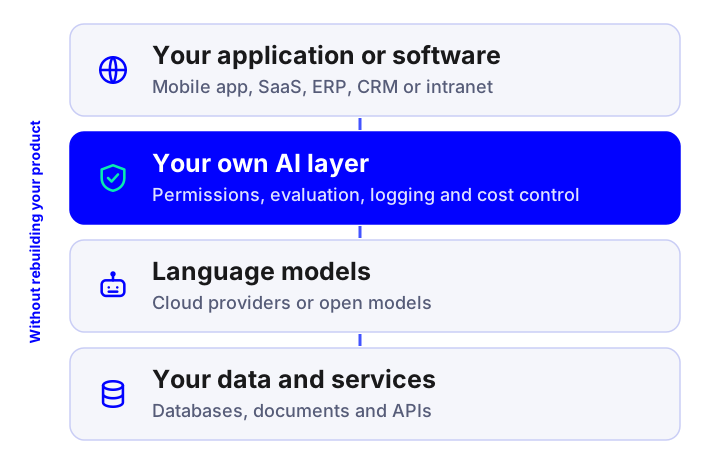
Integrating AI into an application means adding capabilities such as summarising, classifying, extracting data, searching by meaning or conversing inside your current product, without rebuilding it. We create a secure AI layer between your software and the language models, with cost control, quality testing and GDPR compliance.
By Oliver Guirado · Updated on October 28, 2026 · 6 min read
What it means to integrate AI into your application
Most companies do not need a new product: they need the one they already have to do more with less manual work. Integrating AI means connecting your app, your SaaS or your management software to language models through a layer of your own that decides what is sent to the model, what is done with the response and how much it costs.
That layer is the difference between an eye-catching feature and a feature you can maintain: it controls permissions, validates responses, keeps a log for audit, avoids dependence on a single provider and keeps the cost per use under control.
AI features we can add
Summarising and writing
Summarises threads, reports or histories and drafts replies, emails or descriptions inside the workflow.
Classification and routing
Tags tickets, documents and messages, prioritises them and sends them to the right team.
Data extraction
Reads invoices, contracts, forms or delivery notes and fills structured fields with validation.
Semantic search
Finds by meaning, not just by keyword, in your database or documentation.
Incident summarising and classification in fleet management software
Problem
Managers received a growing volume of free-text incidents from drivers and workshops. Classifying, summarising and assigning them was slow and varied depending on who reviewed them.
Solution
An AI layer inside the product that classifies each incident by type and urgency, writes a summary and proposes the owner and the action. The manager accepts, edits or rejects, and those changes feed the evaluation.
Steps
Review of the data model and of a history of labelled incidents.
Design of the AI layer: prompts, output validation and logging.
Evaluation against cases the team had already resolved.
Integration into the existing interface with manual acceptance.
Cost control per customer and gradual roll-out as a premium feature.
Target outcome
Consistently classified incidents, managers with more time for complex cases and an AI feature the product can sell. More on logistics software.
Technology
Existing backend (REST API), AI service in Python, language model with structured output, metrics dashboard.
Sample project · E-learning
Assisted quiz generation in a training platform
Problem
Trainers spent hours preparing quizzes and exercises from their materials, and the quality was uneven.
Solution
A feature that, from a syllabus or document, proposes questions at different levels with their answers and explanations. The trainer reviews and publishes; the system avoids repetition and keeps the course style.
Steps
Analysis of the question types the platform uses.
Design of the generator with a structured format and quality criteria.
Tests with trainers and tuning of difficulty levels.
Integration with the course editor and usage limits per account.
Target outcome
Faster content preparation with human review and a differentiating feature compared with other platforms. More in e-learning platforms.
Technology
Existing web platform, language model API with structured response, job queue.
The projects on this page are illustrative, anonymised examples of how we approach this kind of work. Every real project is defined with your information, your systems and your goals.
How we integrate AI without breaking your product
Technical review: architecture, data and available APIs, and the points where AI adds the most value.
AI layer design: providers, input and output format, validations, logging and a cost-per-use budget.
Evaluable prototype: the feature working on real data and measured against a set of cases.
Integration: into your backend and interface, with feature flags to switch it on per customer or plan.
Security and privacy: minimising the data sent, anonymisation where appropriate and agreements with providers.
Observability: quality, latency and cost metrics, alerts and a continuous improvement process.
Technology and architecture decisions
Provider independence: the AI layer abstracts the model, so changing it (or using an open one) does not force you to rewrite the application.
Structured output: we ask for validated JSON, not free text, so the rest of the system can rely on the result.
Caching and queues: we reduce cost and latency and absorb usage peaks.
Automated evaluation: every model or prompt change is tested against a set of cases.
Sensitive data: filtering, anonymisation and, when necessary, models deployed on your infrastructure.
We work on your current stack (Node.js, Python, PHP, .NET, Java) and create clean APIs with our API development and backend services. For multi-step flows, see AI agents.
Reference prices for AI integration
Scope
Indicative investment
Typical timeline
A single feature (summarising, classification or extraction)
€5,000 – €15,000
3 – 6 weeks
AI module with several use cases, control panel and evaluation
€15,000 – €40,000
2 – 4 months
Product with AI at its core (redesign of flows and architecture)
From €40,000
4 – 8 months
Operation, evaluation and improvement
10 – 20% of the project per year
Ongoing
Indicative reference prices in euros, excluding VAT, for projects in Spain and Europe in 2026. The final amount depends on scope, integrations and data quality; we confirm it with a fixed quote after a first meeting.
The cost of using the model is variable: we estimate it at the start and pass it on per account or per plan so the feature is profitable from the first customer.
Frequently asked questions
Can AI be integrated into an application that already exists?
Yes. An AI layer is added that connects to your backend and your interface through APIs, without rebuilding the product. It works with mobile apps, SaaS, ERP, CRM or intranets.
How much does it cost to integrate AI into an app or software?
A single feature usually costs between €5,000 and €15,000; a module with several use cases and a control panel, between €15,000 and €40,000. A product redesigned with AI at its core starts at €40,000. These are reference prices excluding VAT.
Which language model is used?
It depends on the case: models from the main providers or self-hosted open models. We design the layer so you can change model without rewriting the application.
What happens to my customers' data?
We send only what is essential, anonymise where appropriate, sign data processing agreements with the providers and, if necessary, use models deployed on your infrastructure.
How is the model usage cost controlled?
With caching, per-account limits, choosing the right model for each task and consumption metrics. We estimate it before starting so the feature is profitable.
How do I know the AI answers with quality?
We build a set of test cases with expected results and run it before every change. In production we measure users' acceptances and corrections.
Shall we talk about your project?
Tell us about your case and we will reply within 24-48 hours with a proposed scope and an indicative quote.