Artificial intelligence for industry and manufacturing
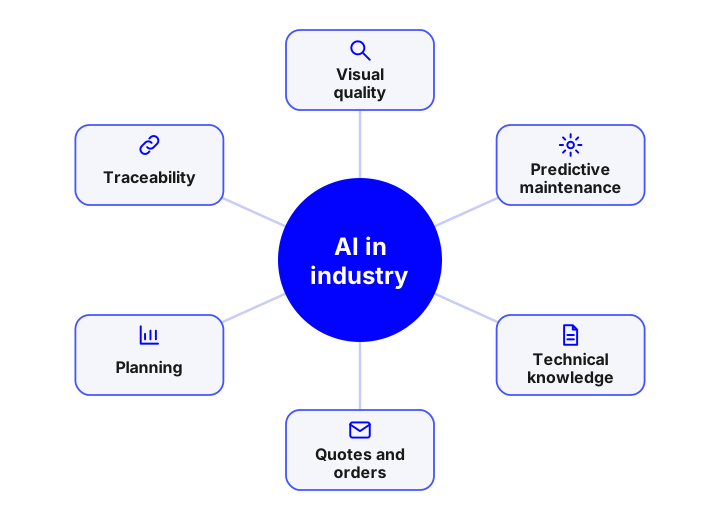
In industry, AI contributes on four fronts: quality (visual inspection), predictive maintenance, technical knowledge (an assistant over manuals, standards and past projects) and sales management (quotes, orders, documents). It integrates with your ERP, MES and shop-floor systems and is validated with real data before scaling.
By Oliver Guirado · Updated on October 28, 2026 · 4 min read
Why industry gets so much out of AI
Plants generate data (sensors, production, quality) and technical knowledge scattered across manuals, standards and the heads of veterans. AI turns both into decisions: it detects failures before they stop the line, inspects at production speed and puts technical knowledge within reach of the whole team.
Demand forecasting and support for sequencing with shop-floor constraints.
Traceability and documentation
Certificates, quality reports and batch documentation generated and filed.
Sample AI projects in industry and manufacturing
Sample project · Manufacturing
Predictive maintenance in a processing plant
Problem
Unplanned breakdowns stopped lines and calendar-based maintenance replaced parts that still had useful life.
Solution
A system that analyses sensor signals, learns the normal pattern and warns of deviations in time to plan the intervention, with a dashboard per machine.
Steps
Review of sensors and breakdown history.
Anomaly model validated against past breakdowns.
Alerts integrated with the maintenance system.
Tuning with the actual interventions.
Target outcome
Planned interventions instead of unexpected stoppages and better use of spare parts.
Technology
Sensor and IoT data, anomaly detection, alerts and dashboard.
Sample project · Equipment manufacturer
Technical and quoting assistant for a made-to-order manufacturer
Problem
Every quote required finding similar projects, datasheets and prices in scattered folders; the knowledge depended on a few people.
Solution
An assistant using RAG over projects, datasheets and price lists that proposes the quote structure, cites sources and leaves the draft to the salesperson for review.
Steps
Inventory of documents and permissions by area.
Preparation and indexing with OCR of drawings and datasheets.
Evaluation with quotes already made.
Integration with the ERP and the CRM.
Target outcome
Faster, more consistent quotes and technical knowledge accessible to the whole team.
Technology
RAG with permissions, OCR, integration with ERP and CRM.
The projects on this page are illustrative, anonymised examples of how we approach this kind of work. Every real project is defined with your information, your systems and your goals.
Data, integrations and compliance
Plant data: sensors, MES and quality; their history and labelling determine what is possible.
Security and OT: separation between plant and office networks, minimum access and on-premises deployment when needed.
Industrial property: confidential drawings, formulas and processes should not leave for external services without an agreement; we use models on your own infrastructure if required.
Functional safety: AI that influences machine safety requires validation and specific standards.
Where to start
Choose a critical line or machine with a history of failures or defects.
Start with technical knowledge or quotes, with low risk and a quick return.
Pilot visual quality or predictive maintenance with metrics against the current method.
Scale by line and plant with a common architecture.
Reference prices for AI in industry and manufacturing
What is usually implemented first
Indicative investment
Typical timeline
Technical knowledge and quoting assistant
€15,000 – €50,000
2 – 4 months
Predictive maintenance on one line
€20,000 – €70,000
3 – 6 months
In-line visual inspection
€25,000 – €80,000
3 – 6 months
Indicative reference prices in euros, excluding VAT, for projects in Spain and Europe in 2026. The final amount depends on scope, integrations and data quality; we confirm it with a fixed quote after a first meeting.