AI voice assistants and phone agents for businesses
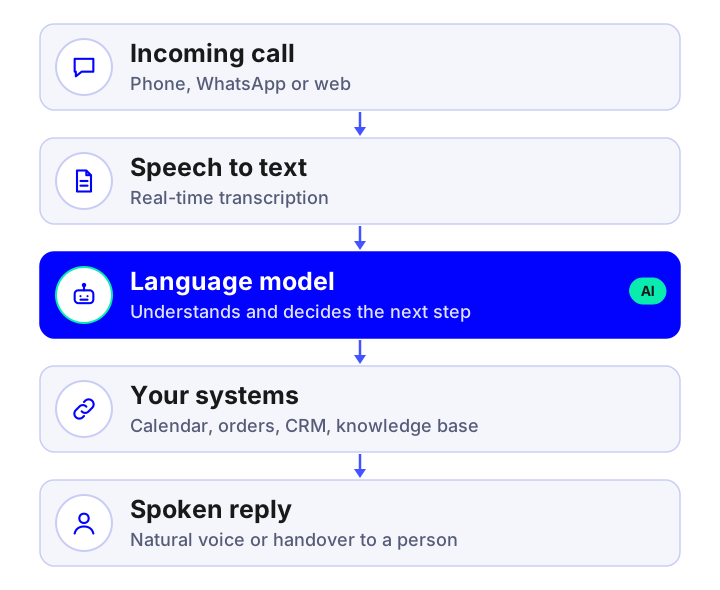
An AI voice assistant answers calls naturally: it understands what the person says, checks your systems (calendar, orders, CRM), replies out loud and passes the call to a human when the case calls for it. It suits bookings, appointments, incidents and first-line support, at any hour and with no queues, and it is transparent about being an automated system.
By Oliver Guirado · Updated on October 28, 2026 · 6 min read
What an AI voice assistant is and how it differs from a phone menu
A classic phone menu (“press 1 for sales”) forces the caller to adapt to the machine. An AI voice assistant does the opposite: people speak in their own words, interrupt and correct themselves, and the system understands the intent. Behind it are three pieces: speech recognition, a language model that decides, and tools connected to your systems to do real things (check an order, move an appointment, open an incident).
It is the voice version of an AI chatbot and, when the system has to run complete processes, it relies on the same architecture as an AI agent. If you are unsure between a voice or a text channel, most projects start with the one that concentrates the most repetitive calls.
Voice AI use cases
Bookings and appointments
Confirms, changes and cancels appointments in clinics, restaurants, garages or professional services using the real calendar.
First-line support
Captures the reason for the call, resolves simple things and hands complex ones over with a summary already written.
Order status and incidents
Checks an order’s status or opens an incident with the details the caller gives.
Low latency: a long pause breaks the conversation. We design for the reply to start within a couple of seconds and for the caller to be able to interrupt.
Robust recognition: accents, noise, proper names, plate numbers, addresses and numbers. It is evaluated with real recordings of your calls.
Confirmation of critical data: the system repeats dates, amounts and personal details before carrying out an action.
Handover to a person: with clear rules (anger, an explicit request, out-of-scope topic) and with the context already transcribed.
Brand voice and tone: a natural synthetic voice, short sentences and a tested conversation script.
Continuous evaluation: call reviews, resolution metrics and weekly improvement.
Sample voice assistant projects
Sample project · Healthcare
Phone appointment agent for a network of clinics
Problem
Reception handled calls to book, change and cancel appointments with lines saturated at peak hours; many calls were lost and others were resolved with details taken by hand.
Solution
A voice assistant connected to the real calendar that manages appointments, sends confirmation by SMS or WhatsApp and answers administrative questions. For symptoms or clinical doubts it says so clearly and passes the call to a person.
Steps
Analysis of recordings and reasons for calling by specialty.
Design of the script, confirmations and handover to reception.
Integration with the management software and the telephony.
Privacy review and information for the caller.
Pilot in one centre, call review and rollout.
Target outcome
Fewer missed calls, reception free for in-person care and traceability of every appointment handled. More on this in AI for clinics and healthcare.
Technology
Cloud telephony, speech to text and text to speech, language model, management software API.
Sample project · Restaurants
Voice assistant for bookings and orders for a restaurant group
Problem
During service nobody could pick up the phone; bookings were lost and takeaway orders were noted down with mistakes.
Solution
An assistant that answers the phone, checks availability, takes bookings and takeaway orders with confirmation of details and sends them to the venue’s system. Special cases go to the manager.
Steps
Map of reasons for calling and availability rules.
Connection to the booking and ordering system.
Tests with simulated calls and dining-room noise.
Launch venue by venue with weekly review.
Target outcome
Fewer lost bookings and fewer mistakes in orders, with the team focused on the dining room.
Technology
Cloud telephony, voice AI, booking system via API, call review panel.
The projects on this page are illustrative, anonymised examples of how we approach this kind of work. Every real project is defined with your information, your systems and your goals.
How we build a voice assistant
Call analysis: reasons, volume, peak hours, current resolution and calls that end up with a person.
Conversation design: script, tone, confirmations, scope limits and rules for handover to a human.
Integration: telephony, calendar, CRM or ERP, with minimum permissions.
Evaluation: tests with real recordings and simulated calls; measurement of comprehension and errors.
Gradual launch: first a percentage of calls or a time slot.
Continuous improvement: call review, new intents and script tuning.
Privacy, recording and transparency
Information for the caller: they are told from the start that they are speaking to an automated assistant and offered a person.
Recording and transcription: only with a legal basis and prior notice; limited retention and role-based access (GDPR).
Voice as personal data: we avoid using it to identify the person unless there is a clear legal basis; voice biometrics fall under a special regime.
Providers: data processing agreements and, if needed, processing in the EU.
Synthetic voices: a real person’s voice is not imitated without their explicit consent.
Voice assistant for one defined case (appointments or first-line support) with one integration
€12,000 – €35,000
6 – 12 weeks
Phone agent with several flows, integrations and a call review panel
€30,000 – €80,000
3 – 6 months
Maintenance, call review and improvement
€500 – €2,000 / month
Ongoing
Indicative reference prices in euros, excluding VAT, for projects in Spain and Europe in 2026. The final amount depends on scope, integrations and data quality; we confirm it with a fixed quote after a first meeting.
On top of these amounts come variable usage costs: telephony, speech to text, language model and synthetic voice, which we calculate with you based on call minutes. Details on the factors in how much an AI chatbot or agent costs.
Frequently asked questions
What is an AI voice assistant?
It is a system that answers calls speaking naturally: it understands what the person says, checks your systems, replies with synthetic speech and passes to a human when needed.
How much does an AI phone agent cost?
An assistant for one defined case with one integration usually costs between €12,000 and €35,000; one with several flows, integrations and a review panel, between €30,000 and €80,000. These are reference prices excluding VAT, plus variable per-minute usage cost.
Do I have to say it is an AI?
Yes. It is advisable, and generally required, to say from the start that the caller is speaking to an automated system and to offer a person.
Can calls be recorded?
Yes, with a legal basis, prior notice, limited retention and restricted access, in line with the GDPR. We define it with you before launch.
Does it understand accents and noise?
Quality depends on the speech recognition and the environment. It is measured with real recordings of your calls and confirmations are designed for critical data. No system is perfect, which is why handover to a person exists.
Does it integrate with my calendar or CRM?
Yes, via API or import, as long as the system allows it. We check before quoting.
Shall we talk about your project?
Tell us about your case and we will reply within 24-48 hours with a proposed scope and an indicative quote.