Artificial intelligence for logistics and transport
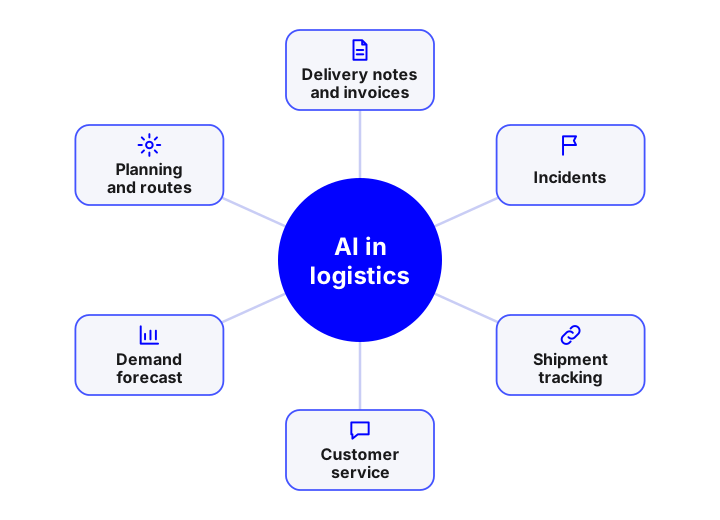
In logistics, AI saves the most time where there are many documents and many exceptions: delivery notes, invoices, incidents, customer emails and shipment tracking. It also supports demand forecasting and planning. We connect it to your TMS or ERP with human review of the exceptions.
By Oliver Guirado · Updated on October 28, 2026 · 4 min read
Why logistics is good ground for AI
Logistics generates an enormous volume of unstructured information: PDF delivery notes, emails with delivery changes, photos of incidents, customer queries across several channels. A large part of the team's work is reading, comparing and typing. With AI it becomes data the system can use and people deal with the exceptions.
We build logistics software; AI integrates with your TMS, ERP and warehouse.
AI use cases in logistics and transport
Document reading
Delivery notes, CMRs, invoices and orders become validated data in your system.
Automatic entry of transport documents at a logistics operator
Problem
Delivery notes arrived by email, portal and driver photo, and were typed in by hand with billing delays and discrepancies.
Solution
A pipeline that extracts the data with OCR and AI, validates it against the order and rate and creates the record in the system; discrepancies go to a queue with the image and the reason.
Steps
Sample of real documents and validation rules.
Extraction and measurement of accuracy per field.
Integration with the TMS and the email.
Review panel and extension by customer.
Target outcome
Less typing, more agile billing and traceability of every data point back to its document.
Technology
OCR and extraction AI, rules, TMS API, review panel.
Sample project · Freight transport
Incident and customer communication agent
Problem
The traffic team answered dozens of status queries every day and handled incidents by email and phone, with scattered information.
Solution
An agent that classifies each email, checks the shipment status, replies with up-to-date data and, if there is an incident, opens the case with the context and proposes the action. The manager approves whatever involves cost or a route change.
Steps
Analysis of contact reasons and of TMS statuses.
Connection to the TMS and the mailbox.
Approval rules for actions with a cost.
Pilot with a group of customers and roll-out.
Target outcome
Immediate replies, fewer interruptions for the team and a clear record of every incident.
Technology
TMS via API, agent with minimum permissions, language model, approvals panel.
The projects on this page are illustrative, anonymised examples of how we approach this kind of work. Every real project is defined with your information, your systems and your goals.
Data, integrations and compliance
Documents and TMS data: the quality of the source information determines accuracy.
Customer and driver data: GDPR, minimisation and contracts with AI providers.
Integrations: TMS, ERP, warehouse, telematics and email through APIs.
Human control: approval of actions with a cost, route changes or claims.
Where to start
Quantify the typing and repeated queries of the traffic and administration team.
Start with documents or with status communication, whichever has more volume.
Add incident management with approvals.
Move to forecasting and planning once the data is in order.
Reference prices for AI in logistics and transport
What is usually implemented first
Indicative investment
Typical timeline
Transport document reading with validation
€10,000 – €30,000
6 – 12 weeks
Incident and shipment status agent
€15,000 – €50,000
2 – 4 months
Demand and capacity forecasting
€20,000 – €70,000
2 – 5 months
Indicative reference prices in euros, excluding VAT, for projects in Spain and Europe in 2026. The final amount depends on scope, integrations and data quality; we confirm it with a fixed quote after a first meeting.
Mainly in reading documents (delivery notes, invoices), managing incidents and queries, shipment tracking, demand forecasting and planning, connected to your TMS or ERP.
Does it integrate with my TMS or ERP?
Yes, through an API, database or file import. We review the available route before quoting.
How much does it cost to automate delivery note reading?
Between €10,000 and €30,000 depending on document types and integrations. These are reference prices excluding VAT.
What happens to documents the AI does not read well?
They go to a review queue with the image and the reason. The corrections are used to improve the system.
Can the AI change routes on its own?
It can propose them, but actions with a cost or an impact on the customer require approval from a person.
Shall we talk about your project?
Tell us about your case and we will reply within 24-48 hours with a proposed scope and an indicative quote.