Machine learning and predictive analytics development for business
Machine learning learns from your historical data to predict what will happen (demand, customer churn, machine failure, non-payment) and to detect what is anomalous. Unlike generative AI, it works with structured data and produces measurable results. We build the model, integrate it into your systems and keep it monitored in production.
By Oliver Guirado · Updated on October 28, 2026 · 6 min read
What machine learning is and when it beats generative AI
Machine learning trains models on examples from the past to predict or classify new cases. It is the technology behind demand forecasting, customer scoring and fraud detection. Generative AI (language models) is excellent with text and documents, but it does not replace a model trained on your own figures when the problem is to predict a number or a probability.
Many projects combine both: a predictive model calculates the risk and an assistant explains the reason in natural language.
Predictive analytics use cases
Demand and stock forecasting
What will sell, where and when, so you buy and produce with fewer stock-outs and less surplus.
Churn and purchase propensity
Which customers are about to leave or buy, so you can act in time with the right action.
Scoring and prioritisation
Scoring of leads, opportunities or applications so the team works first on what pays off most.
Predictive maintenance
Detects failure signals in sensors and schedules the intervention before the stoppage.
Anomaly and fraud detection
Transactions, invoices or logins outside the pattern flagged for review.
Pricing and optimisation
Adjustment of prices, routes, shifts or allocations within business constraints.
Sample machine learning projects
Sample project · Retail
Demand forecasting by store and product for a retail chain
Problem
Purchasing relied on experience and on last year's spreadsheet. There were stock-outs on fast-moving items and surpluses on others.
Solution
A model that predicts demand by store and item using sales history, calendar, promotions and weather, with a dashboard that proposes replenishment quantities and shows the uncertainty.
Steps
Audit of sales, stock and promotion data.
Baseline model and advanced model, compared with the current method over a historical period.
Dashboard for buyers with recommendations and an explanation of the factors.
Integration with the ERP and a periodic retraining process.
Tracking of forecast error in production.
Target outcome
Replenishment better matched to demand, fewer stock-outs and less tied-up stock, with the final decision in the hands of the purchasing team.
Technology
Python, time series and gradient models, data warehouse, web dashboard, scheduled retraining.
Sample project · Industry
Predictive maintenance for a plant with critical machinery
Problem
Unplanned breakdowns stopped entire lines and calendar-based preventive maintenance replaced parts that still had useful life.
Solution
A system that analyses vibration, temperature and consumption to detect patterns that precede a breakdown, warns in advance and recommends the most suitable intervention.
Steps
Review of available sensors and breakdown history.
Data preparation and a definition of what counts as a "failure" for the model.
Anomaly and remaining-life models, validated against past breakdowns.
Alerts integrated into the maintenance system.
Continuous tuning with the actual interventions.
Target outcome
Planned interventions instead of unexpected stoppages and better use of spare parts. More on AI for industry.
Technology
Sensor and IoT data, anomaly detection models, alerts and a dashboard in the maintenance system.
The projects on this page are illustrative, anonymised examples of how we approach this kind of work. Every real project is defined with your information, your systems and your goals.
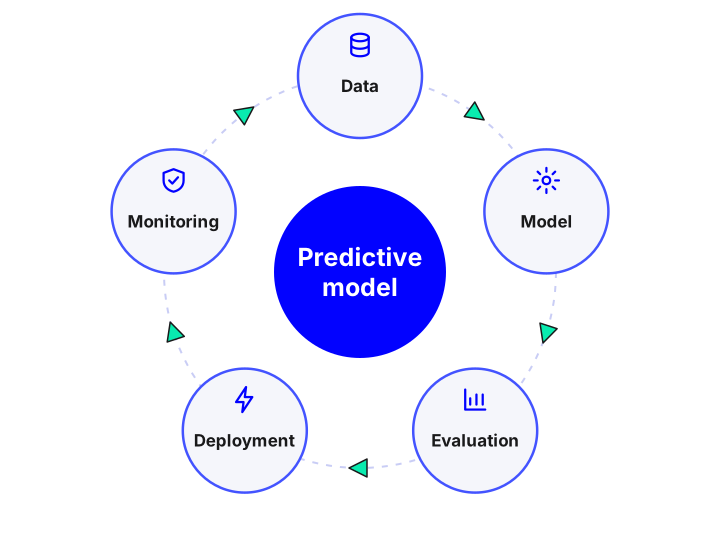
How we develop a machine learning project
Problem and business metric definition: which decision it improves, what error is acceptable and how the benefit is measured.
Data audit: availability, quality, history and bias. This is where the project's viability is decided.
Baseline model: first a simple reference (what you use today or a rule) to know how much machine learning adds.
Modelling and evaluation: candidate models, validation on unseen data and error analysis.
Deployment: an API or batch process integrated with your systems, with model version control.
Monitoring (MLOps): data drift detection, quality alerts and planned retraining.
If you do not yet know whether your data is enough for a model, an AI diagnostic answers it in a few weeks.
Explainability, bias and regulation
Explainability: models show which variables weigh in each prediction, so the team can trust them and correct them.
Bias: we check whether the model performs worse for any group, especially when it affects people (credit, insurance, recruitment).
GDPR: legal basis, minimisation and, where there are automated decisions with significant effects, the right to human intervention.
EU AI Act: some uses (creditworthiness assessment, employment, life and health insurance) are considered high risk and require additional documentation, oversight and testing. We assess this when designing the project.
Platform with several models, MLOps and dashboards
From €70,000
5 – 9 months
Monitoring, retraining and improvement
10 – 20% of the project per year
Ongoing
Indicative reference prices in euros, excluding VAT, for projects in Spain and Europe in 2026. The final amount depends on scope, integrations and data quality; we confirm it with a fixed quote after a first meeting.
The factor that weighs most is the state of the data: if it has to be collected or cleaned, part of the budget goes there. We connect the model to your software through AI integration in applications.
Frequently asked questions
What is predictive analytics?
It is the use of machine learning models trained on historical data to estimate what will happen (demand, churn, breakdown, non-payment) and to support decisions with probabilities instead of hunches.
How much data do I need for a machine learning model?
It depends on the problem. As a guide, a history of a few hundred useful cases can be enough for simple models and several thousand or more for complex ones. The data audit confirms it before you invest.
How much does a machine learning project cost?
A proof of concept costs between €8,000 and €20,000; a model in production integrated into your systems, between €20,000 and €70,000. These are reference prices excluding VAT.
What is the difference between machine learning and generative AI?
Machine learning predicts or classifies from structured data; generative AI creates or interprets text, images and documents. They are often combined in the same project.
How long does it take to go live?
A proof of concept takes 4 to 8 weeks and a model in production 2 to 5 months, depending on integrations and the state of the data.
How do I know the model keeps working well over time?
The quality of the predictions and changes in the data (drift) are monitored, with alerts and scheduled retraining.
Shall we talk about your project?
Tell us about your case and we will reply within 24-48 hours with a proposed scope and an indicative quote.