Custom AI app development for businesses and startups
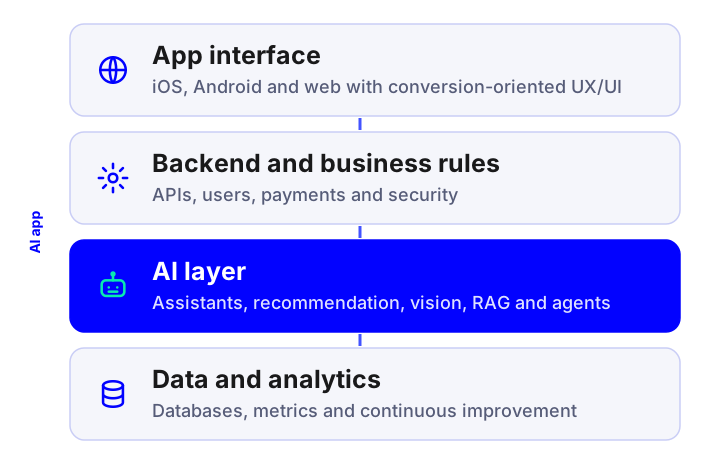
Developing an AI app means designing a mobile or web application in which artificial intelligence solves a central part of the product: an assistant, recommendations, reading documents or images, forecasts or automation. We handle strategy, UX/UI design, development, the AI and the launch, with reference prices and clear timelines.
By Oliver Guirado · Updated on October 28, 2026 · 7 min read
What an AI app is and how it differs from a traditional app
A traditional app does exactly what it was programmed to do. An AI app interprets language, images or data and adapts: it understands what the user writes or says, recommends what is most relevant for each person, extracts information from a photo or a document and automates routine decisions.
AI is not a marketing add-on: it must solve a concrete problem (less friction, more conversion, lower operating cost). That is why we start by validating the use case and the data before designing screens. If you already have an application, it may be enough to integrate AI into your existing software; if you are after a mobile-centred product, also see mobile apps with artificial intelligence.
Types of AI apps we build
Assistants and chat
Copilots inside the app that guide the user and carry out actions.
Support and booking app with an assistant for a services startup
Problem
The startup was growing faster than its support team: users waited hours for an answer and dropped out before booking.
Solution
A mobile app with a built-in assistant that answers questions, proposes services according to the profile, manages bookings and passes complex cases to a person.
Steps
Validation of the use case with real user conversations.
UX/UI design of the conversational and booking flow.
Development of the cross-platform app and the backend.
AI layer with a knowledge base and scope limits.
Phased launch and measurement of conversion and resolution.
Target outcome
An immediate response in the app, more completed bookings and a human team dedicated to high-value cases.
Technology
Flutter or React Native, Node.js or Python backend, language model with RAG, product analytics.
Sample project · Retail
Recommendation app for a shop with physical and online stores
Problem
The catalogue was broad and customers could not find what they were looking for; the app was barely used beyond checking opening hours.
Solution
An app with natural-language search, recommendations based on purchases and browsing, and personalised stock and new-arrival alerts.
Steps
Analysis of the purchase and browsing data available.
Design of the search and recommendation experience.
Recommendation model and semantic search over the catalogue.
A/B tests with a share of the users.
Deployment and improvement with usage data.
Target outcome
More use of the app, product discovery and a base for personalised campaigns. More in m-commerce apps.
Technology
Native or cross-platform app, semantic search, recommendation engine, metrics dashboard.
Sample project · Maintenance and technical services
Computer-vision inspection app for a technical service
Problem
Technicians filled in inspection reports by hand and the photos were not reliably linked to each incident.
Solution
An app that detects elements and possible defects in photos, fills in the inspection sheet, attaches evidence and syncs with the management system, with the technician's confirmation.
Steps
Collection and labelling of photos from real inspections.
Training and evaluation of the vision model.
Field app with offline mode and synchronisation.
Integration with the management system and technician validation.
Target outcome
Faster, more uniform reports, with traceability of the evidence.
Technology
Mobile app, vision model on the device or in the cloud, management system API.
The projects on this page are illustrative, anonymised examples of how we approach this kind of work. Every real project is defined with your information, your systems and your goals.
Our process for developing an AI app
Validation of the idea and the business model: users, problem, available data and success metrics.
UX/UI design: a clickable prototype and user testing, with a focus on conversion. More in app UX/UI design.
Architecture and choice of AI: what is solved with language models, when with classic models and what runs on the device.
Development and evaluation: app, backend and AI with a quality test set from the start.
Launch and continuous improvement: publication in the stores, product metrics and improvement cycles.
We can start with an MVP to validate the market and build on it. If the app is cross-platform we work with Flutter and React Native, and also with native apps for iOS and Android.
AI tools to build apps or custom development?
AI and no-code tools are useful for prototyping and validating ideas, and in the guide to tools for developing apps with AI we compare the best ones. Their limits appear when you need integrations with your systems, control of data, performance, security and an experience of your own. Our usual recommendation: prototype with tools, validate with users and build custom what is going to sustain the business.
How much it costs to develop an AI app
Scope
Indicative investment
Typical timeline
AI MVP (one central use case, one platform)
€25,000 – €60,000
3 – 5 months
Full AI app, iOS and Android, admin panel and integrations
€60,000 – €180,000
5 – 10 months
Platform with several AI features and scalable architecture
From €180,000
9 months or more
Maintenance, evolution and AI usage cost
10 – 20% per year
Ongoing
Indicative reference prices in euros, excluding VAT, for projects in Spain and Europe in 2026. The final amount depends on scope, integrations and data quality; we confirm it with a fixed quote after a first meeting.
The factors that move the price most are the number of AI features, the integrations, the quality of the data and whether there are security or compliance requirements. For a tailored estimate, ask for a mobile app development quote.
Common mistakes when developing an AI app
Choosing the technology before defining the problem and the success metric.
Not validating the idea with users before investing in development.
Underestimating the quality and volume of data needed.
Forgetting the model usage cost when calculating profitability.
Not planning for scalability, security and maintenance from day one.
For startups, small businesses and large companies
Startups
An AI MVP to validate fast, with an architecture that scales without rebuilding.
Small businesses
Apps and internal tools that automate processes and improve customer service.
Large companies
Integration with corporate systems, security, data governance and phased deployment.
We work with teams in Spain and Latin America from our offices in Madrid and Barcelona, and we can design the app for several languages and markets.
Frequently asked questions
Which companies can benefit from developing an AI app?
Any company with customer service, sales, operations or analysis processes that consume time: from startups that want a differentiating product to small and large companies looking for efficiency.
How much does it cost to develop an AI app?
An AI MVP costs between €25,000 and €60,000 and a full app for iOS and Android with integrations, between €60,000 and €180,000. These are reference prices excluding VAT; the final quote is agreed after a meeting.
How long does it take to develop an AI app?
An MVP usually takes 3 to 5 months and a full app 5 to 10 months, depending on integrations and AI features.
Can I develop an AI app if I only have an idea?
Yes. We start by validating the idea, defining the use case and designing a prototype. You need no technical knowledge or prior data to begin.
Is it possible to integrate AI into an app I already have?
Yes, normally without rebuilding it: an AI layer is added, connected through an API to your backend and interface, with control of permissions and costs.
What is the difference between using AI tools and hiring custom development?
Tools are for prototyping. Custom development brings integrations, data control, security, performance and an experience of your own, which are essential when the app is part of the business.
Is it safe to develop apps with artificial intelligence?
Yes, with minimum permissions, data minimisation and protection, GDPR compliance, evaluation of answer quality and human oversight for sensitive decisions.
How do I start an AI app project?
Tell us your idea and goals in the form. We reply within 24-48 hours with a proposed scope and an indicative quote.
Shall we talk about your project?
Tell us about your case and we will reply within 24-48 hours with a proposed scope and an indicative quote.