Computer vision and OCR with AI: reading documents and images
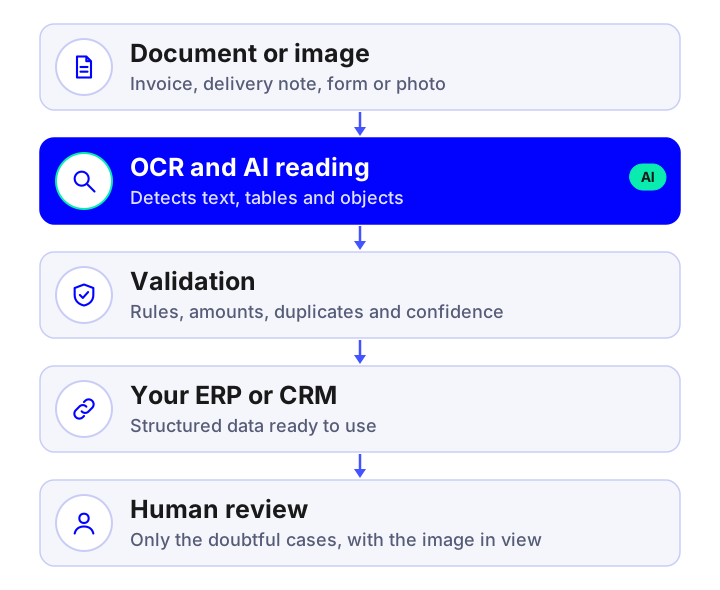
Computer vision and OCR with AI turn images and documents (invoices, delivery notes, forms, product photos or production line photos) into structured data your systems can use. We read, validate and send the information to your ERP or CRM, and leave for human review whatever is not reliable.
By Oliver Guirado · Updated on October 28, 2026 · 6 min read
What computer vision is and how it differs from traditional OCR
Classic OCR recognises characters in an image and works well with identical, clean documents. With real documents (invoices from hundreds of suppliers, crooked photos, tables, handwriting) it breaks down. Computer vision with AI understands the content: where the amount is, which line is a product, whether an object is damaged. Today we combine OCR, vision models and multimodal language models to read each document along with its structure.
Automatic entry of delivery notes and invoices for a logistics operator
Problem
Thousands of delivery notes and carrier invoices arrived every month as PDFs, photos and scanned paper. They were typed in by hand, with errors and billing delays.
Solution
A pipeline that receives the documents by email and portal, extracts header and lines with OCR and AI, validates against orders and rates and creates the record in the system. Documents with low confidence or discrepancies go to a review queue with the image and the reason.
Steps
Collection of a real sample of documents and of the validation rules.
Extraction with OCR and AI and measurement of accuracy per field.
Validation rules and duplicate control.
Integration with the management system and review panel.
Extension by document type and by supplier.
Target outcome
Less typing, faster billing and traceability of every data point back to its source document. More in AI for logistics.
Technology
OCR and extraction AI, rules in Python, management system API, review panel.
Sample project · Industry
Visual quality inspection on a production line
Problem
Visual control was done by operators at the end of the line; fatigue and variability let defective parts through and caused returns.
Solution
In-line cameras with a vision model that detects the most frequent defects, rejects or flags the part and stores the image with the decision. The operator reviews the doubtful cases and the corrections retrain the model.
Steps
Study of the defect type, lighting and capture points.
Collection and labelling of images with the quality team.
Training, validation and threshold tuning.
Integration with the line and quality record.
Continuous improvement with the operators' corrections.
Target outcome
More consistent control, traceability of every part and fewer returns for visible defects. More in AI for industry.
Technology
Industrial cameras, vision model on a machine in the plant, integration with the quality system.
The projects on this page are illustrative, anonymised examples of how we approach this kind of work. Every real project is defined with your information, your systems and your goals.
Accuracy, validation and human control
We measure accuracy per field, not just overall: a misread amount matters more than an address with a typo.
Confidence score: what is certain passes through on its own; what is doubtful goes to review with the image in front of the reviewer.
Business validations: sums and taxes that add up, known supplier, duplicates and comparison with the order.
Continuous improvement: every human correction is used to evaluate and improve the system.
Device or cloud: inspection on the shop floor usually runs on a local machine for latency and privacy; document reading runs in the cloud with data processing agreements.
Privacy and regulation
Documents contain personal and financial data: we apply minimisation, encryption, limited retention and data processing contracts with providers. Facial recognition and other uses of biometric data have a special regime under GDPR and the EU AI Act (some are prohibited or high risk): we assess them case by case and recommend review by your legal adviser. For the general framework, read AI, GDPR and the AI Act.
Reference prices for computer vision and OCR
Scope
Indicative investment
Typical timeline
Extraction of one document type with validation and review
€8,000 – €20,000
4 – 8 weeks
Pipeline for several document types integrated with your ERP
€20,000 – €50,000
2 – 4 months
In-line visual inspection (cameras, model and integration)
€25,000 – €80,000
3 – 6 months
Maintenance, evaluation and improvement
10 – 20% of the project per year
Ongoing
Indicative reference prices in euros, excluding VAT, for projects in Spain and Europe in 2026. The final amount depends on scope, integrations and data quality; we confirm it with a fixed quote after a first meeting.
Frequently asked questions
What is computer vision?
It is the technology that lets a system interpret images and video: read documents, detect defects, recognise products or count objects, and turn what it sees into data your systems can use.
What is the difference between OCR and OCR with AI?
Classic OCR recognises characters and needs almost identical documents; OCR with AI understands the structure (fields, tables, lines) and works with variable documents such as invoices from many suppliers.
What accuracy can be achieved when reading invoices?
It depends on the quality and variety of the documents. We measure accuracy per field on your real sample and design human review for the doubtful cases; there is no universal figure.
How much does it cost to automate invoice reading?
One document type with validation and review costs between €8,000 and €20,000, and a pipeline for several types integrated with your ERP, between €20,000 and €50,000.
Can it be integrated with my ERP or accounting software?
Yes, through an API, a database or file import. We review the available route before quoting.
Is it legal to recognise faces or identity documents?
Biometric and identity data have a special regime under GDPR and the EU AI Act, and some uses are prohibited or high risk. It must be assessed case by case with legal advice.
Shall we talk about your project?
Tell us about your case and we will reply within 24-48 hours with a proposed scope and an indicative quote.