Artificial intelligence for e-commerce and online stores
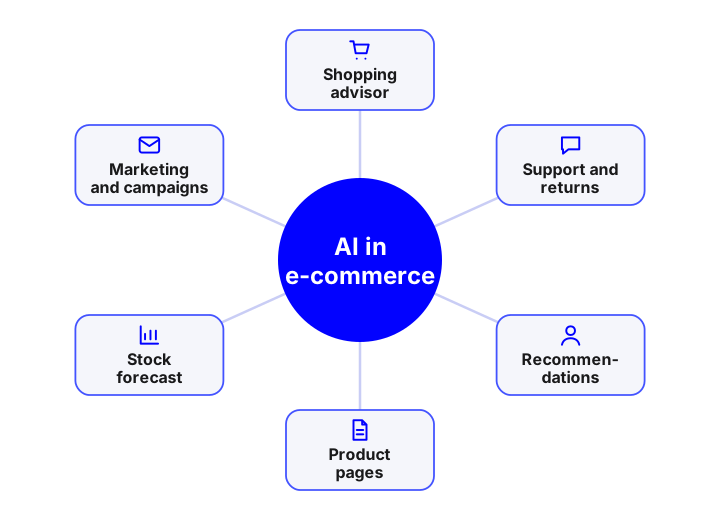
AI in e-commerce works best where volume and friction are highest: support and returns, shopping guidance, recommendations, product pages, stock forecasting and order synchronisation. We build these features into your store and your ERP, and measure the impact on conversion and support cost.
By Oliver Guirado · Updated on October 28, 2026 · 5 min read
Why AI matters in an online store
An online shop handles thousands of repetitive interactions: where is my order, how do I return this, which size should I pick, which product suits me. Each one costs the team time and, if the reply is slow, costs a sale. AI lets you support, advise and automate at any hour and with the same standard, so people can focus on what needs judgement.
We work on top of your platform (WooCommerce, Shopify, PrestaShop, Magento or a custom build) and connect it to the ERP, the warehouse and the carrier. If you are still setting up the store, see online store development and m-commerce apps.
AI use cases in e-commerce
Support and after-sales
Order status, exchanges and returns over web chat and WhatsApp, with real actions in the store.
Shopping and after-sales assistant for a home-decor store
Problem
A wide catalogue with many size and finish combinations created doubts before purchase and a lot of delivery and return queries afterwards.
Solution
An assistant in the store that recommends by space and style using the real catalogue, calculates delivery times, handles returns and passes complaints to a person.
Steps
Analysis of the most repeated queries and of the policies.
Connection to the platform, the stock and the carrier.
Knowledge base with size and finish guides.
Tests with real conversations and phased launch.
Measurement of the conversion of sessions with the assistant.
Target outcome
Fewer repetitive queries, better-informed buyers and a team focused on high-value cases.
Technology
E-commerce platform via API, semantic catalogue search, language model, WhatsApp Business.
Sample project · Marketplace
Assisted product-page generation and translation for a marketplace
Problem
Thousands of seller products with incomplete pages in a single language, which limited search ranking and conversion.
Solution
A workflow that completes attributes, writes descriptions and translates into several languages using brand rules, and leaves each page in review before it is published.
Steps
Definition of the product-page template and the style rules.
Generation workflow with attribute validation.
Review panel with changes highlighted.
Batch publishing and measurement of the effect on traffic.
Target outcome
A more complete, multilingual catalogue without growing the team. More in marketplace development.
Technology
Catalogue API, n8n or Python workflows, language model, review panel.
The projects on this page are illustrative, anonymised examples of how we approach this kind of work. Every real project is defined with your information, your systems and your goals.
Data, integrations and compliance
Customer and order data: minimisation, legal basis and agreements with AI providers (GDPR).
Catalogue and policies: answer quality depends on having products, shipping and returns well documented.
Integrations: store, ERP, warehouse, carrier, payment gateway and CRM through APIs.
Transparency: tell the customer they are talking to an AI system and always offer human contact.
Where to start
Measure your queries: which questions repeat and how much they cost.
Start with support and returns, where the return is fastest.
Add a shopping advisor and recommendations once there is usage data.
Scale to forecasting and catalogue using the metrics of the first pilot.
Reference prices for AI in e-commerce
What is usually implemented first
Indicative investment
Typical timeline
Support and order chatbot connected to the store
€9,000 – €30,000
6 – 12 weeks
Shopping advisor and semantic search
€12,000 – €40,000
2 – 4 months
Product-page and translation workflow with review
€6,000 – €25,000
4 – 10 weeks
Demand and stock forecasting
€20,000 – €70,000
2 – 5 months
Indicative reference prices in euros, excluding VAT, for projects in Spain and Europe in 2026. The final amount depends on scope, integrations and data quality; we confirm it with a fixed quote after a first meeting.
To support and advise customers at any hour, automate returns and orders, recommend products, improve catalogue pages and forecast demand and stock.
Does it work with WooCommerce, Shopify or PrestaShop?
Yes. We connect through APIs to the usual platforms and to your ERP, warehouse and carrier.
How much does a chatbot for an online store cost?
A support and order chatbot connected to the store costs between €9,000 and €30,000, depending on channels and integrations. These are reference prices excluding VAT.
Can the AI recommend products that do not exist?
A well-designed system only recommends products from your real catalogue, with current price and stock, and cites the link. It is evaluated before launch.
Is it GDPR compliant?
Yes, with data minimisation, customer information, contracts with the AI providers and the option of human contact.
Shall we talk about your project?
Tell us about your case and we will reply within 24-48 hours with a proposed scope and an indicative quote.