
Guide · Artificial intelligence
OpenAI, Claude, Gemini or open models: how to choose the AI model for your company
There is no "best" language model in the abstract: you choose by task, with your own evaluation on your data. Commercial models (OpenAI, Anthropic, Google and others) give the highest quality with the least effort; self-hosted open models give data control and predictable costs. It pays to design the system so you can switch models.
The criteria that matter
| Criterion | What to ask yourself |
|---|---|
| Quality on your task | Does it answer well with your documents, your language and your format? It is measured with your own cases, not with public rankings. |
| Privacy and data location | Where is the data processed, is it used for training, is there a data processing agreement? |
| Cost per use | How much does it cost at your real volume? Small models are enough for classifying or extracting. |
| Latency | Does it respond fast enough for your experience (chat, voice, real time)? |
| Tools and structured output | Does it support function calls, reliable JSON format, images or audio if you need them? |
| Provider dependence | Can you switch model without rewriting the system? |
| Availability and limits | Quotas, stability and support suitable for production? |
Commercial, open or hybrid models
Commercial models
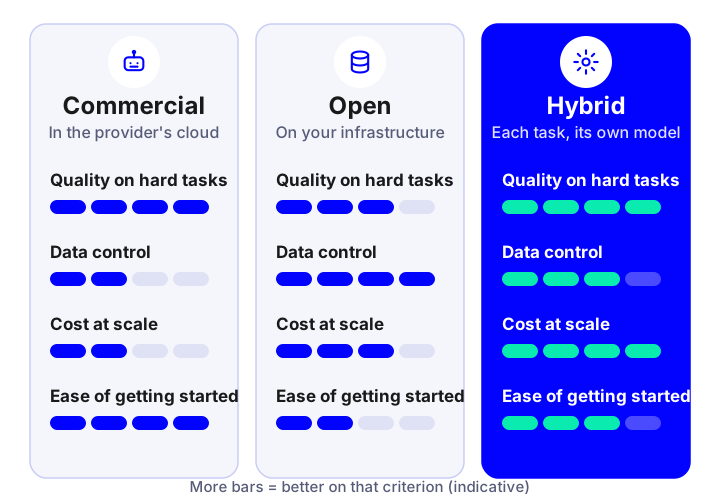
Offered by providers such as OpenAI, Anthropic or Google through an API. Higher quality and less effort to start; data is processed on their infrastructure under contract.
Open models
Models with available weights (for example from the Llama or Mistral families) that you deploy on your infrastructure. More data control and predictable costs at volume; they need a technical team and more tuning work.
Hybrid approach
A powerful model for reasoning and small or open models for massive or sensitive tasks. It usually gives the best balance.
The capabilities and prices of each model change every few months; that is why it pays not to marry one.
How to evaluate with your data (the method we use)
- Create a set of real cases (30-100) with the expected answer, including hard cases and exceptions.
- Define the metric: accuracy, completeness, format, tone and, where relevant, correct citations.
- Test 2-4 models with the same prompt and data, and record quality, latency and cost.
- Review the errors, not just the average: one serious error weighs more than several minor ones.
- Decide by task: it may be a different model for classifying, for writing and for reasoning.
- Repeat when the market changes: with the set of cases, comparing a new model takes hours.
Privacy and compliance
- Check that the provider signs a data processing agreement and what it does with the data (retention, training).
- Consider the processing region and transfers outside the European Economic Area.
- For very sensitive data or industrial property, consider open models on your infrastructure.
- Minimise and anonymise what is sent to the model.
More in AI, GDPR and the AI Act. In AI integration in applications we explain how we design the layer that lets you switch model, and usage costs are in this price guide.
Frequently asked questions
Which AI model is best for a company?
It depends on the task. The right approach is to evaluate several models with your company's real cases and choose by quality, cost, privacy and latency. A hybrid approach usually gives the best balance.
Are open models worth using?
Yes when you need data control, predictable costs at high volume or deployment on your infrastructure, accepting more technical work and sometimes slightly lower quality on very complex tasks.
Do providers use my data to train their models?
It depends on the contract and plan. With business API use it can usually be avoided; it must be verified in writing and a data processing agreement signed.
Can I switch model later?
Yes, if the system is designed with an abstraction layer and a set of quality tests. It is one of the most important architecture decisions.
How do I compare models objectively?
With a set of 30-100 real cases with expected answers, the same instructions for each model and measurement of quality, latency and cost.
Shall we talk about your project?
Tell us about your case and we will reply within 24-48 hours with a proposed scope and an indicative quote.
Tell us about your project
Describe what you want to achieve and which systems you work with. We reply within 24-48 hours.
Artificial intelligence services and guides
Everything we do with AI for business, from the diagnostic to the product in production. Artificial intelligence for business.
Services
- AI agents for businessSystems that plan and carry out tasks on your CRM, ERP and email.
- Custom AI chatbots24/7 support and sales on web and WhatsApp, connected to your systems.
- Assistant over your company documents (RAG)An AI that answers with your information and cites the source.
- AI integration in apps and softwareAdd language models to your product without rebuilding it.
- Artificial intelligence consultingDiagnostic, prioritised cases and a roadmap with return.
- Machine learning and predictive analyticsDemand forecasting, churn, anomalies and predictive maintenance.
- Computer vision and OCR with AIReading invoices and delivery notes and image-based quality inspection.
- Custom AI app developmentApps and platforms with AI built in from the design stage.
- Process automation with AIWorkflows that save hours of manual work.
- AI voice assistantsPhone agents that answer calls and book appointments using your systems.
- AI recommendation systemsPersonalisation and recommendations measured with A/B tests.
Guides
- AI agent, chatbot or assistant: differences
- How much an AI chatbot or agent costs
- What RAG is and how to use it in your company
- AI use cases in business by department
- How to implement AI in a small business
- n8n, Make, Zapier or custom development
- AI, GDPR and the AI Act: what to review
- How to measure the ROI of an AI project
- How to appear in ChatGPT and AI Overviews
- What is MCP (Model Context Protocol)
- Automation with n8n for business
- 17 tools to develop apps with AI
- Mobile apps with artificial intelligence
- 10 AI automations for small businesses
- WhatsApp Business with AI: customer service
- AI in mobile apps: device or cloud
AI by sector
- AI for e-commerce
- AI for real estate
- AI for clinics and healthcare
- AI for logistics and transport
- AI for human resources
- AI for insurance and brokerage
- AI for industry and manufacturing
- AI for hospitality and restaurants
- AI for law and accounting firms
- AI for education and e-learning