
Guide · GEO
How to appear in ChatGPT, Perplexity and Google AI Overviews
For AI assistants to cite your website you need good technical SEO, content that answers your customers' questions directly, structured data, a consistent brand mentioned in reliable external sources, and periodic measurement of the answers. There are no guarantees or shortcuts: it is about being the best source for that question.
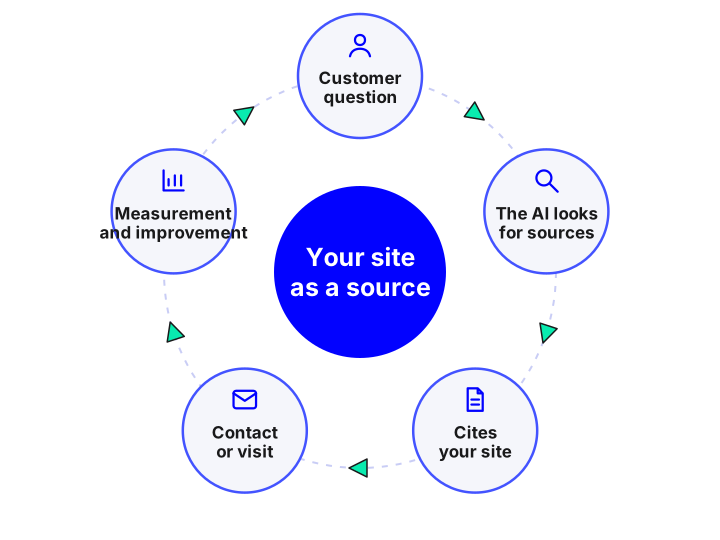
How AI assistants decide whom to cite
Assistants with Internet access (ChatGPT with search, Perplexity, Gemini, Copilot, Google AI Overviews) do something like this: they rephrase the question, retrieve pages from a search engine or their own index, extract the most useful passages and compose an answer with a few sources. When they do not use search, they answer from what they learned in training, where widely mentioned brands carry weight.
Two fronts follow from this: being retrievable and useful (your website) and being known and mentioned (your brand in other sources). The first depends largely on how your website is built (accessible HTML, performance, structured data); the second is brand and content work.
Six steps to improve your presence
- A solid SEO base. Indexing, speed, clear structure and internal links. If the search engine cannot find you, neither can the assistant.
- Define your customers' questions. List how they would ask at each stage ("which company do you recommend for…", "how much does… cost", "difference between…").
- Answer first. Open each page with a 40-60 word summary that answers the question, and then expand with tables, lists and examples. It is the format that is most easily extracted.
- Include concrete, verifiable information: reference prices, timelines, steps, requirements and comparisons. Models cite the specific more than the generic.
- Structured data and brand entity. Organization, Service, Article, FAQ and Person schemas; the same name and description on your site and your profiles; author pages.
- External mentions. Sector directories, media, collaborations, reviews and communities where your company is discussed in context.
The technical side: what to check on your site
| Element | What to check |
|---|---|
| robots.txt | Do not block by accident the crawlers of the AI assistants you want to read you; decide with judgement which to allow |
| Performance and HTML | Content accessible in the HTML without depending on heavy scripts; fast pages |
| Sitemap and internal links | All important pages linked and in the sitemap |
| Structured data | Valid JSON-LD consistent with what is seen on the page |
| llms.txt | Optional: a summary for models; there is no evidence that on its own it improves citations |
| Dates and authorship | A visible update date and an identifiable author |
Types of content that tend to be cited
Definitions and guides
"What is…" and "how to…" with a direct answer, steps and examples.
Example: what is RAG →How to measure whether it works
- A fixed set of questions (40-60) tested every month in several assistants, recording whether you appear, how and which sources they cite.
- Referral traffic from assistant domains in your analytics.
- Enquiries with clues: ask in the form "how did you hear about us?" to capture "an AI recommended you".
- Search Console for impressions and clicks on answer pages.
AI answers vary between runs: measure the trend with repeated samples, not with a single test.
What to avoid
- Promises of a guaranteed "position 1 in ChatGPT": nobody controls those answers.
- Mass-generated content without information of your own: systems reward what is useful and specific.
- Structured data that does not match what is visible on the page.
- Hiding text or manipulating content for models: it can lead to penalties.
If your website needs technical adjustments (performance, structured data, accessible HTML), tell us about your case.
Frequently asked questions
How can I appear in ChatGPT answers?
By combining technical SEO, content that answers your customers' questions directly, structured data, a consistent brand and mentions in reliable external sources, and measuring every month how you are cited.
Can you pay to appear in ChatGPT or Perplexity?
Organic answers cannot be bought. Some platforms have their own advertising formats, which are different from organic AI visibility.
Does traditional SEO help with AI Overviews?
Yes. AI Overviews rely on Google's index, so a well-ranked website with clear, useful content starts with an advantage.
What is llms.txt and should I create it?
It is a proposed file to summarise your website for language models. It can be included as a complement, but there is no evidence that on its own it improves citations.
How long does it take to appear in AI answers?
It depends on how often the systems retrieve your site and on the competition. Changes can show up in weeks or months; it pays to measure with a fixed set of questions.
Shall we talk about your project?
Tell us about your case and we will reply within 24-48 hours with a proposed scope and an indicative quote.
Tell us about your project
Describe what you want to achieve and which systems you work with. We reply within 24-48 hours.
Artificial intelligence services and guides
Everything we do with AI for business, from the diagnostic to the product in production. Artificial intelligence for business.
Services
- AI agents for businessSystems that plan and carry out tasks on your CRM, ERP and email.
- Custom AI chatbots24/7 support and sales on web and WhatsApp, connected to your systems.
- Assistant over your company documents (RAG)An AI that answers with your information and cites the source.
- AI integration in apps and softwareAdd language models to your product without rebuilding it.
- Artificial intelligence consultingDiagnostic, prioritised cases and a roadmap with return.
- Machine learning and predictive analyticsDemand forecasting, churn, anomalies and predictive maintenance.
- Computer vision and OCR with AIReading invoices and delivery notes and image-based quality inspection.
- Custom AI app developmentApps and platforms with AI built in from the design stage.
- Process automation with AIWorkflows that save hours of manual work.
- AI voice assistantsPhone agents that answer calls and book appointments using your systems.
- AI recommendation systemsPersonalisation and recommendations measured with A/B tests.
Guides
- AI agent, chatbot or assistant: differences
- How much an AI chatbot or agent costs
- What RAG is and how to use it in your company
- AI use cases in business by department
- How to implement AI in a small business
- n8n, Make, Zapier or custom development
- How to choose the AI model for your company
- AI, GDPR and the AI Act: what to review
- How to measure the ROI of an AI project
- What is MCP (Model Context Protocol)
- Automation with n8n for business
- 17 tools to develop apps with AI
- Mobile apps with artificial intelligence
- 10 AI automations for small businesses
- WhatsApp Business with AI: customer service
- AI in mobile apps: device or cloud
AI by sector
- AI for e-commerce
- AI for real estate
- AI for clinics and healthcare
- AI for logistics and transport
- AI for human resources
- AI for insurance and brokerage
- AI for industry and manufacturing
- AI for hospitality and restaurants
- AI for law and accounting firms
- AI for education and e-learning