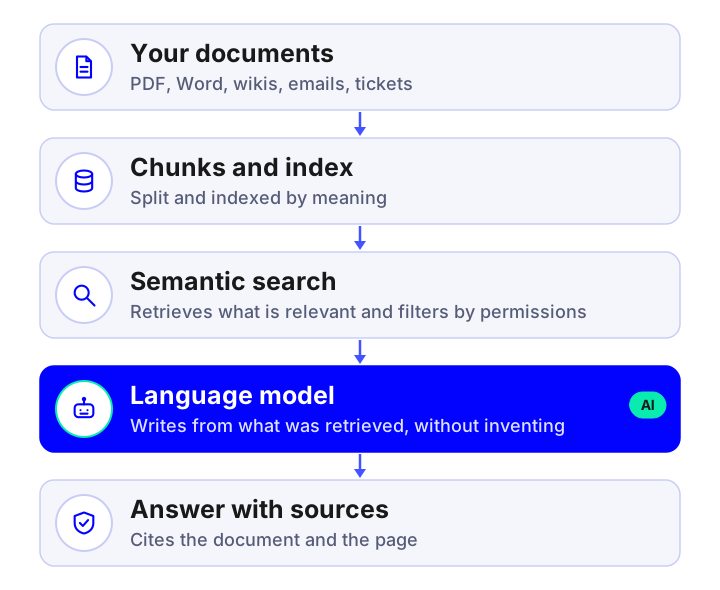
A RAG assistant is an AI that, before answering, searches your company's documents (contracts, manuals, tickets, wikis, emails) and replies with that information, citing the source. It avoids made-up answers, respects who can see what and stops being a generic AI to become an expert in your business.
By Oliver Guirado · Updated on October 28, 2026 · 6 min read
What RAG is and why it matters to a company
RAG (Retrieval-Augmented Generation) is the technique that makes a language model answer with your information instead of what it learned on the Internet. The model is not "trained" on your data: on every question, the system searches for the relevant chunks of your documents and hands them to the model to write the answer.
For a company this means three things: up-to-date answers (you just update the document), verifiable answers (each one links to its source) and controllable answers (each user only accesses what they are entitled to). If you want an explanation without jargon, read what RAG is and how to use it in your company.
What an assistant over your documents is for
Internal knowledge
Procedures, policies, manuals and regulations available to the whole workforce in one conversation.
Support and customer service
Consistent answers for customers and for the support team, with the source in view.
Retrieves cases, terms and datasheets to prepare quotes in minutes.
Legal and compliance
Searches clauses, compares contract versions and finds obligations, with review by a professional.
Engineering and product
Consults technical reports, specifications and decisions from earlier projects.
Training and onboarding
Turns documentation into a tutor that answers every new hire.
What makes RAG really work (and not just in the demo)
A RAG prototype can be put together in a day; a system the workforce uses every week requires care over several details:
Data preparation: cleaning, de-duplication, versions and metadata (date, area, confidentiality). Answer quality depends on document quality.
Smart chunking: splitting by meaningful sections, not by character count, so each chunk is self-sufficient.
Hybrid search and re-ranking: combining semantic and keyword search, and re-ranking results by relevance.
Permissions: filtering by user and role before searching, so nobody sees what they should not.
Verifiable citations: each answer indicates the document and section; if there is no evidence, the assistant says so.
Continuous evaluation: a bank of questions with expected answers measures accuracy and detects regressions.
With this approach the assistant can evolve into an AI agent that, besides answering, carries out actions in your systems.
Sample RAG assistant projects
Sample project · Engineering and construction
Technical reports assistant for an engineering firm
Problem
Years of projects spread across folders, PDFs and emails: preparing a quote or settling a technical question meant searching by hand or asking the most senior colleagues.
Solution
An internal assistant that indexes reports, descriptive drawings, studies and applicable regulations. It answers technical questions, finds similar projects and cites document and section. Each area only sees its own folders.
Steps
Inventory of sources and definition of permissions by area.
Ingestion, cleaning and text extraction from PDFs and scans with OCR.
Chunking by sections, hybrid index and re-ranking.
Evaluation with real questions written by the technical team.
Web interface and deployment with corporate sign-in (SSO).
Target outcome
Less time spent searching for information, faster quotes and knowledge that does not depend on who is in the office. More about the construction sector.
Technology
Document extraction with OCR, vector database, hybrid search, language model with EU data, SSO.
Sample project · Insurance
Policy wording assistant for an insurance broker
Problem
Comparing coverage, exclusions and excesses across the policy wordings of dozens of insurers took time and raised doubts in front of the customer.
Solution
An assistant that consults the current wordings, answers about coverage and exclusions with a verbatim citation and summarises differences between products. It always shows the original text and does not replace the professional's review.
Steps
Collection and versioning of wordings by insurer and line.
Structured extraction of coverage and exclusions for precise searches.
Answers with verbatim citation and guided comparison.
Review by the broker team and tuning of edge cases.
Target outcome
Faster, more consistent answers to the customer, with traceability of the text that backs them.
Technology
Document extraction, index by line and insurer, language model, review panel.
The projects on this page are illustrative, anonymised examples of how we approach this kind of work. Every real project is defined with your information, your systems and your goals.
How we build a RAG assistant
Inventory and goals: which sources exist, who uses them, which questions must be answered and how we measure success.
Data preparation: cleaning, versions, metadata and text extraction, including OCR.
Prototype with real questions: a first version evaluated with the team's own cases.
Security and permissions: access by user, query logging and GDPR compliance.
Deployment: web interface, widget in your intranet, Teams or Slack, or integration into your application.
Maintenance: automatic index updates, continuous evaluation and improvement based on unanswered queries.
Your documents are not used to train public models. Depending on sensitivity, we deploy the system in your cloud, in a European region or with open models on your own infrastructure. We apply encryption, role-based access control, query logging and configurable retention, and we sign the data processing agreements that GDPR requires.
Reference prices for a RAG assistant
Scope
Indicative investment
Typical timeline
Proof of concept with one data source and evaluation
€4,000 – €9,000
2 – 4 weeks
Production assistant with several sources, permissions and citations
€12,000 – €35,000
6 – 12 weeks
Multi-area corporate platform with SSO, audit and continuous evaluation
€35,000 – €90,000
3 – 6 months
Operation and continuous improvement
10 – 20% of the project per year
Ongoing
Indicative reference prices in euros, excluding VAT, for projects in Spain and Europe in 2026. The final amount depends on scope, integrations and data quality; we confirm it with a fixed quote after a first meeting.
The cost varies mainly with the volume and state of the documents (scans, duplicate versions), the number of connected sources and the security requirements. More context in how much an AI chatbot or agent costs.
Frequently asked questions
What does RAG mean in artificial intelligence?
It stands for retrieval-augmented generation: before answering, the system searches for relevant information in your documents and hands it to the language model, which writes the answer citing the source.
Are my documents used to train the AI?
No. In a RAG system the documents are indexed in your environment and queried on every question; they are not used to train public models. We confirm this by contract with each provider.
How much does a RAG assistant cost for a company?
A proof of concept is around €4,000 – €9,000; a production assistant with several sources, permissions and citations, between €12,000 and €35,000; and a multi-area corporate platform, between €35,000 and €90,000. These are reference prices.
Can it respect each user's permissions?
Yes. The system filters by user and role before searching, so each person only gets answers based on documents they already have access to.
Which document formats does it support?
PDF, Word, Excel, presentations, emails, web pages, wikis and databases. For scanned documents we use OCR and check extraction quality.
What is the difference between RAG and training (fine-tuning) a model?
Fine-tuning adjusts the model for a style or task; RAG gives it access to changing information with citations. For company knowledge, RAG is usually cheaper, easier to keep up to date and easier to audit.
Shall we talk about your project?
Tell us about your case and we will reply within 24-48 hours with a proposed scope and an indicative quote.