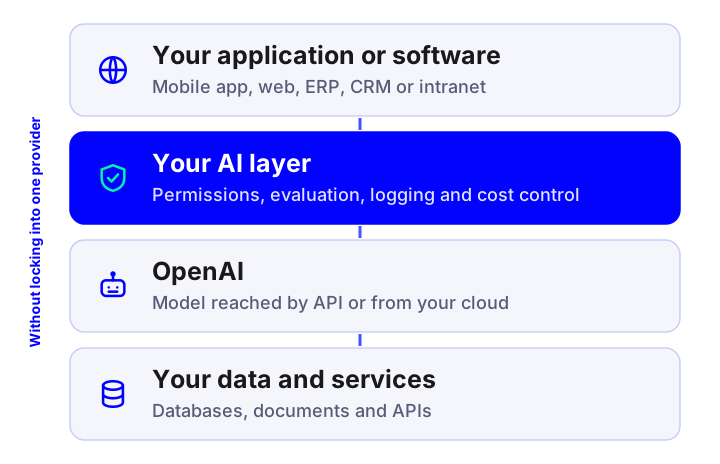
We build applications, chatbots, agents and integrations on OpenAI. We choose the model and the access route for quality, cost, privacy and latency, and design the system with a layer of your own so you can change provider without rebuilding your product. Everything is evaluated on your data before going live.
By Oliver Guirado · Updated on October 28, 2026 · 6 min read
What we build with OpenAI
OpenAI is one of the most widely used families of language models in business. What matters is not the model itself but how it is integrated: with your data, your permissions and your processes, and with an evaluation that shows it works. These are the most common applications:
Chatbots and assistants
Customer support and internal help using your company’s information.
When OpenAI fits (and when to consider another option)
Usual strengths
A very broad ecosystem of tools, libraries and documentation.
General-purpose models with good performance in reasoning, writing and coding.
Function calling, structured output, vision and voice within the same API.
Also available through Microsoft Azure, useful if you already work on Azure or need European regions.
When to consider another option
If data cannot leave your infrastructure: a self-hosted open model.
If cost per use is critical at high volume: smaller models or other providers.
If your cloud is AWS or Google Cloud: their managed services can simplify contracts and security.
Model capabilities and prices change every few months. That is why we do not decide by reputation: we evaluate 2 or 3 models on your own cases. If you are torn between providers, read how to choose the AI model for your company.
How we access the model and where your data lives
We can access OpenAI models directly through its API or through Microsoft Azure, which lets you choose a region and fit your contracts and security policies.
A layer of your own between your software and the model: permissions, response validation, logging and spending limits, and the ability to change provider.
Data in the EU when needed: a European region, data processing agreements and minimisation of what is sent.
No training on your data: we check by contract and plan that your data is not used to train models.
Sample projects
Sample project · Services
Customer support assistant over your documents
Problem
The support team answered the same questions again and again and the information was spread across manuals, emails and a website.
Solution
An assistant on the web and WhatsApp that answers from your documents, cites the source and hands over to a person with the context when it cannot resolve the question. Built on OpenAI with an AI layer of your own for permissions and evaluation.
Steps
Inventory of sources and real questions.
Prototype evaluated on known cases.
Integration with web, WhatsApp and helpdesk.
Gradual launch and weekly review of conversations.
Target outcome
Fewer repetitive questions for the team and consistent answers with their source.
Technology
OpenAI, knowledge base with semantic search, messaging channels, review panel.
Sample project · Administration
Data extraction and validation from contracts and invoices
Problem
Data from hundreds of documents a month was keyed in by hand, with errors and delays.
Solution
A flow that reads the documents with OpenAI, extracts the key fields, validates them with rules and leaves doubtful ones for review, with traceability back to the document.
Steps
Sample documents and validation rules.
Extraction and per-field accuracy measurement.
Integration with the ERP or accounting software.
Exceptions panel and continuous improvement.
Target outcome
Less manual entry and data traceable to its source.
Technology
OpenAI, OCR where needed, Python rules, ERP API.
The projects on this page are illustrative, anonymised examples of how we approach this kind of work. Every real project is defined with your information, your systems and your goals.
How we work
Use case and data: which process improves, with what information and what will be measured.
Model and access choice: we compare options on your real cases.
Evaluable prototype: a defined version with a test set.
Integration and security: minimum permissions, logging and GDPR compliance.
Launch and continuous improvement: metrics, review and cost tuning.
Security and compliance
GDPR: legal basis, minimisation and data processing agreements with the provider.
Transparency: users are told they are interacting with an AI system and offered a person.
Human oversight for critical actions and decisions that affect people.
Assistant or chatbot in production with one integration
€9,000 – €35,000
6 – 12 weeks
Agent with several tools and human approval
€20,000 – €60,000
2 – 4 months
Maintenance and improvement
10 – 20% of the project per year
Ongoing
Indicative reference prices in euros, excluding VAT, for projects in Spain and Europe in 2026. The final amount depends on scope, integrations and data quality; we confirm it with a fixed quote after a first meeting.
On top of these amounts comes the model usage cost, which depends on volume and which we estimate before starting. Details in how much an AI chatbot or agent costs.
Frequently asked questions
Is OpenAI the best model for my company?
It depends on the task. We evaluate 2 or 3 models on your real cases and choose for quality, cost, privacy and latency. With a layer of your own you can change model later.
Is my data used to train OpenAI models?
It depends on the contract and plan. With business use of the API it can usually be avoided; we check it in writing and sign a data processing agreement.
How much does developing with OpenAI cost?
A proof of concept costs between €4,000 and €9,000; an assistant in production, between €9,000 and €35,000; and an agent with several tools, between €20,000 and €60,000. These are reference prices excluding VAT, plus the model usage cost.
Can I switch from OpenAI to another provider later?
Yes, if the system is designed with an abstraction layer and a quality test set. It is one of the most important architecture decisions.
Does it integrate with my current software?
Yes, via API or import, without rebuilding your product. We check before quoting.
Do I have to say that AI is used?
Yes, it is advisable and, in general, required to tell users they are interacting with an AI system and to offer a person.
Shall we talk about your project?
Tell us about your case and we will reply within 24-48 hours with a proposed scope and an indicative quote.