
Guide · Business
How to measure the ROI of an artificial intelligence project
The ROI of an AI project is calculated by comparing the measurable annual benefit (hours saved, errors avoided, additional revenue) minus the annual running cost, against the initial investment. To be credible you must measure the starting situation before beginning and compare against a pilot, not against optimistic estimates.
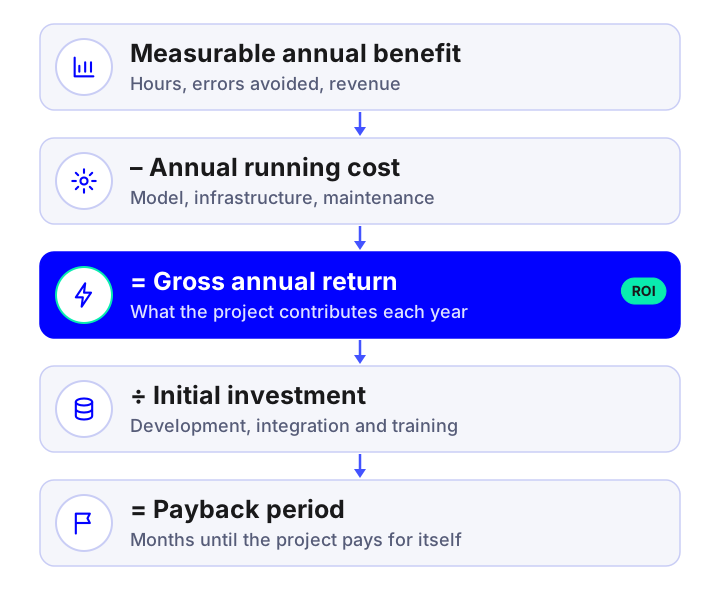
The basic formula
Gross annual return = annual benefit − annual running cost. With that you calculate two numbers any finance department understands:
- Payback period = initial investment ÷ gross annual return (in years or months).
- ROI = (return accumulated over a period − investment) ÷ investment, for example over 3 years.
The hard part is not the calculation but making sure the input data is measured and not assumed.
Which costs to include (the real ones)
Initial investment
Diagnostic, development, integrations, data preparation, security and training.
Annual operation
Model usage, infrastructure, licences, monitoring and maintenance (as a reference, 10 – 20% of the project per year).
Internal costs
Team time to validate, review exceptions and maintain the knowledge base.
Change and adoption
Training and change management, which tend to be underestimated.
The investment ranges for each type of solution are in how much an AI chatbot or agent costs.
Which benefits you can measure
| Type of benefit | How to measure it | Example case |
|---|---|---|
| Time savings | Hours per task before and after × hourly cost | Invoice reading, first-level support |
| Fewer errors | Error rate × average cost of each error | Order capture, reconciliation |
| More revenue | Conversion, qualified leads or attributable sales | Sales chatbot, recommendation |
| Capacity without hiring | Volume handled without growing the team | Customer service at peaks |
| Less risk or penalties | Incidents avoided × cost | Anomaly detection, expiry dates |
| Satisfaction and retention | NPS, response time, drop-out | After-sales assistant |
Avoid counting the same saving twice and do not count as a benefit hours that do not turn into lower cost or more real activity.
Example with assumed figures
To illustrate the method, a support assistant in an online store with made-up assumptions (replace them with your data):
| Item | Assumption |
|---|---|
| Repetitive queries per month | 2,400 |
| Minutes of handling per query | 5 |
| Team cost per hour | €24 |
| Share resolved without a person | 55% |
| Annual benefit from time savings | 2,400 × 5 ÷ 60 × €24 × 55% × 12 = €31,680 |
| Additional attributable sales (prudent assumption) | €6,000 |
| Annual running cost | €7,500 |
| Gross annual return | 31,680 + 6,000 − 7,500 = €30,180 |
| Assumed initial investment | €18,000 |
| Payback period | 18,000 ÷ 30,180 × 12 ≈ 7 months |
With other data the result can be negative: that is precisely why you measure first. An AI diagnostic calculates this kind of business case for your company's candidates.
How to measure rigorously
- Baseline: measure the current process (times, volume, errors, cost) before touching anything.
- Pilot with a control group: compare with a team or period without the tool.
- Quality metrics alongside savings ones: accuracy, satisfaction and human review rate.
- Continuous measurement: a dashboard with consumption, resolution and cost per case.
- Quarterly review of the business case with real data.
The full pilot and scale-up plan is in how to implement AI in a small business, and the cases with the best value-to-effort ratio in use cases by department.
Frequent mistakes when calculating ROI
- Starting from the provider's estimates instead of your own data.
- Ignoring running costs and human review.
- Counting the total hours saved when only a part turns into lower cost.
- Measuring only in the short term: some benefits appear when the system matures.
- Not defining in advance which result would make you cancel or scale the project.
Frequently asked questions
How is the ROI of an AI project calculated?
Subtracting the annual running cost from the measurable annual benefit gives the gross annual return; dividing the initial investment by that return gives the payback period.
Which costs should be included in an AI project?
Initial investment (diagnostic, development, integration, training), annual operation (model, infrastructure, maintenance) and internal costs of review and adoption.
How long does an AI project take to pay for itself?
It depends on the case. Processes with high volume and handling cost can pay for themselves in months; with low volume it may not pay off. It is calculated with data measured in a pilot.
How do I measure savings if the team does not reduce hours?
As capacity: more volume handled without growing the team, less overtime or more time spent on measurable high-value tasks. Only what turns into lower cost or more real activity counts as savings.
Can I calculate the ROI before investing?
Yes, with a business case based on your current data and a bounded pilot that validates it. The AI diagnostic does this for the candidate cases.
Shall we talk about your project?
Tell us about your case and we will reply within 24-48 hours with a proposed scope and an indicative quote.
Tell us about your project
Describe what you want to achieve and which systems you work with. We reply within 24-48 hours.
Artificial intelligence services and guides
Everything we do with AI for business, from the diagnostic to the product in production. Artificial intelligence for business.
Services
- AI agents for businessSystems that plan and carry out tasks on your CRM, ERP and email.
- Custom AI chatbots24/7 support and sales on web and WhatsApp, connected to your systems.
- Assistant over your company documents (RAG)An AI that answers with your information and cites the source.
- AI integration in apps and softwareAdd language models to your product without rebuilding it.
- Artificial intelligence consultingDiagnostic, prioritised cases and a roadmap with return.
- Machine learning and predictive analyticsDemand forecasting, churn, anomalies and predictive maintenance.
- Computer vision and OCR with AIReading invoices and delivery notes and image-based quality inspection.
- Custom AI app developmentApps and platforms with AI built in from the design stage.
- Process automation with AIWorkflows that save hours of manual work.
- AI voice assistantsPhone agents that answer calls and book appointments using your systems.
- AI recommendation systemsPersonalisation and recommendations measured with A/B tests.
Guides
- AI agent, chatbot or assistant: differences
- How much an AI chatbot or agent costs
- What RAG is and how to use it in your company
- AI use cases in business by department
- How to implement AI in a small business
- n8n, Make, Zapier or custom development
- How to choose the AI model for your company
- AI, GDPR and the AI Act: what to review
- How to appear in ChatGPT and AI Overviews
- What is MCP (Model Context Protocol)
- Automation with n8n for business
- 17 tools to develop apps with AI
- Mobile apps with artificial intelligence
- 10 AI automations for small businesses
- WhatsApp Business with AI: customer service
- AI in mobile apps: device or cloud
AI by sector
- AI for e-commerce
- AI for real estate
- AI for clinics and healthcare
- AI for logistics and transport
- AI for human resources
- AI for insurance and brokerage
- AI for industry and manufacturing
- AI for hospitality and restaurants
- AI for law and accounting firms
- AI for education and e-learning