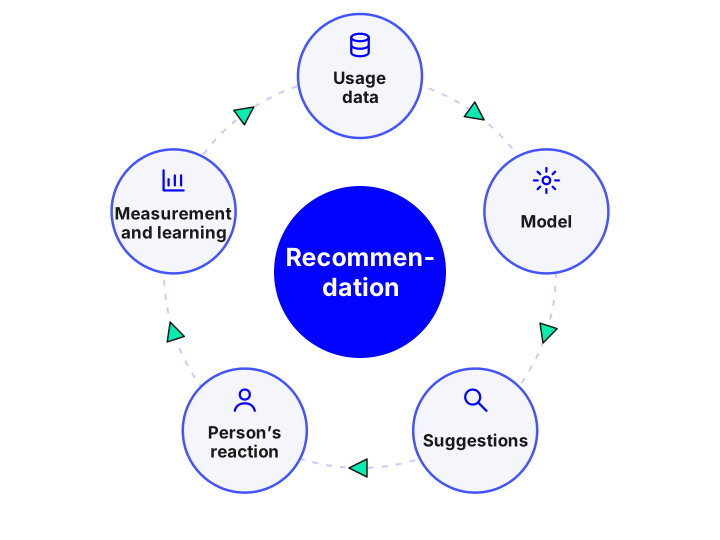
A recommendation system suggests to each person the product, content or action most relevant to them, based on their behaviour, the catalogue and the context. It combines usage data, machine learning models and, increasingly, semantic search with language models. It is validated with A/B tests and measured in conversion, usage or revenue, not hunches.
By Oliver Guirado · Updated on October 28, 2026 · 6 min read
What a recommendation system is and when it pays off
Recommending is deciding what to show each person among many options: products, articles, courses, videos, offers or next actions. It pays off when there is a large catalogue, many users and a measurable goal (purchase, time of use, completion, retention). With few products or few users, a good manual ordering often does better than a model.
Popular items, new arrivals, categories and business rules
Small catalogues or starting without data
Content-based
Recommends items similar to those the person has already used
Few users, good descriptions of the items
Collaborative filtering
Learns from what users with similar tastes do
Many users and a lot of history
Semantic search and recommendation
Represents the meaning of text and images to find what is relevant
Text-rich catalogues, natural-language search
Hybrid
Combines several approaches and adjusts with context
Most real cases
Language models help in two places: understanding natural-language queries (“something comfortable for travelling, under €100”) and explaining why something is suggested. The ranking itself usually still relies on models trained on your data.
Recommendation and personalisation use cases
E-commerce
Related products, “complete the look”, listing order and personalised emails.
What data is needed and how the cold start is solved
Interactions: views, clicks, purchases, searches, ratings and time of use, with consistent identifiers.
Catalogue: descriptions, categories, prices, availability and images, well maintained.
Context: device, moment, location (where relevant and with consent).
Cold start: for new users or products we use rules, popularity and content-based recommendation until there is history.
Event quality: if events are not recorded properly, even the best model does not help; it is the first thing we audit.
Sample recommendation projects
Sample project · E-commerce
Recommendations and semantic search for an online fashion store
Problem
The catalogue was growing and customers could not find what they were looking for; exact-word search returned poor results and emails were generic.
Solution
Natural-language semantic search, related-product blocks and a hybrid recommender for listings and emails, with business rules for stock and margins.
Steps
Audit of events and catalogue quality.
Semantic search and baseline recommender evaluated on historical data.
Integration in product pages, listings and email.
A/B tests with part of the traffic.
Rollout and periodic retraining.
Target outcome
Smoother product discovery and a basis for measuring which recommendations bring real conversion.
Technology
Semantic search, hybrid recommendation model, store API, metrics panel and A/B testing.
Sample project · E-learning
Personalised learning paths on a training platform
Problem
Many learners dropped out because courses did not match their level and they did not know what to do next.
Solution
A system that suggests the next content or exercise based on progress and results, with a short explanation of why it is recommended and control for the learner.
Steps
Analysis of progress and dropout data.
Recommendation model by content and progress.
Integration in the platform and explanation of each suggestion.
The projects on this page are illustrative, anonymised examples of how we approach this kind of work. Every real project is defined with your information, your systems and your goals.
How we build a recommendation system
Goal and metric: which decision is improved and how it will be measured (conversion, revenue per session, completion).
Data audit: events, catalogue, identifiers and volume.
A simple baseline first: rules and popularity as a reference to know what the model adds.
Modelling and evaluation: candidate models, offline evaluation and then A/B tests.
Integration: recommendations API for web, app and email, with fast response.
Monitoring: data drift, quality, diversity and retraining.
Privacy, transparency and bias
GDPR: a legal basis for personalisation, clear information and the possibility to object to profiling.
Options for the person: being able to see why something is suggested, adjust preferences or switch personalisation off.
Online platforms: European digital services rules require transparency about the parameters of recommender systems on certain platforms.
Bias and bubbles: we measure diversity and avoid the system reinforcing only what has already been seen or discriminating against groups.
Recommender in production integrated into web or app, with A/B tests
€18,000 – €55,000
2 – 5 months
Personalisation platform with semantic search, several channels and a dashboard
From €55,000
4 – 8 months
Monitoring, retraining and improvement
10 – 20% of the project per year
Ongoing
Indicative reference prices in euros, excluding VAT, for projects in Spain and Europe in 2026. The final amount depends on scope, integrations and data quality; we confirm it with a fixed quote after a first meeting.
Frequently asked questions
What is a recommendation system?
It is a system that suggests to each person the product, content or action most relevant to them based on their behaviour, the catalogue and the context, normally using machine learning models.
How much data do I need to recommend with AI?
It depends on the approach. With few users, rules and content-based recommendation work well; collaborative filtering needs a large history of interactions. The data audit confirms it before you invest.
How much does a recommendation engine cost?
A proof of concept costs between €6,000 and €18,000; a recommender in production integrated into your web or app, between €18,000 and €55,000. These are reference prices excluding VAT.
How do I know the recommendations work?
With A/B tests: part of the traffic sees the recommendations and part does not, and conversion, revenue or usage are compared. Without that comparison it is easy to credit the system with what would have happened anyway.
Is it GDPR-compliant?
Yes, with a legal basis, clear information, the possibility to object to profiling and data minimisation. We design it that way from the start.
Is a language model useful for recommending?
It helps with understanding natural-language searches and explaining suggestions, but the ranking usually relies on models trained on your behavioural data. The usual approach is to combine them.
Shall we talk about your project?
Tell us about your case and we will reply within 24-48 hours with a proposed scope and an indicative quote.