
Guide · Artificial intelligence
AI agent, chatbot or virtual assistant: differences and how to choose
A chatbot answers questions, a virtual assistant searches for information and writes to help you, and an AI agent plans and carries out tasks in your systems under supervision. The more autonomy, the more potential value, the more complexity and the more care needed with permissions. Most projects start with a chatbot or assistant and evolve into an agent.
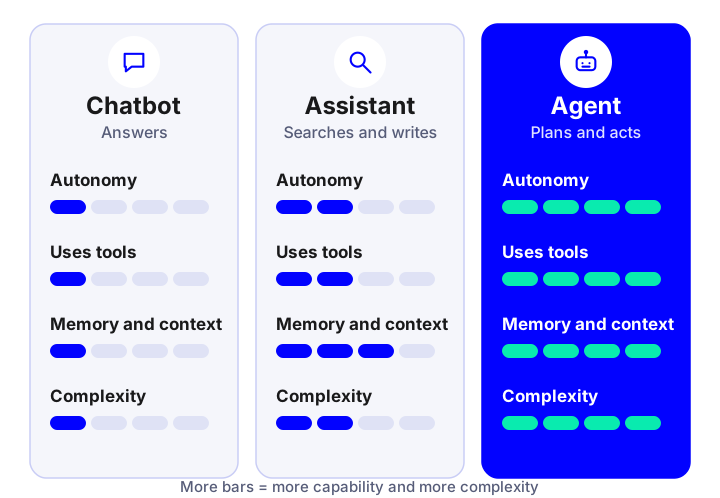
Definitions in one sentence
Chatbot
Holds a conversation and answers questions. It can be rule-based (a tree of options) or generative AI. Its output is text.
AI chatbots →Virtual assistant
A chatbot with access to your information: it searches documents and data, summarises, writes and recommends. It helps a person work better.
RAG assistant →AI agent
Receives a goal, decides the steps and uses tools to carry it out (query, create, send, update) within limits and with human approval.
AI agents →The boundaries are not rigid: many products mix all three. What is useful is to understand what level of autonomy you need and what risk you are willing to take.
Comparison table
| Chatbot | Virtual assistant | AI agent | |
|---|---|---|---|
| What it does | Answers questions | Searches, summarises and writes with your data | Plans and carries out tasks in your systems |
| Who acts | The person decides and acts | The person decides and acts | The agent acts; the person supervises |
| Connection to systems | Optional | Reads documents and data | Reads and writes through tools |
| Main risk | Wrong answer | Wrong answer that looks sourced | Wrong action in a real system |
| Controls needed | Scope and handover | Citations, permissions and evaluation | Minimum permissions, approval, logging and evaluation |
| Indicative investment | From €4,000 | From €9,000 | From €8,000 (bounded task) |
| Example | Answers opening hours and shipping | Answers "what does contract X say about penalties?" | Reads an order by email and creates the quote in the ERP |
The figures are reference prices; the factors that move them are in how much an AI chatbot or agent costs.
The same case with all three options
A customer writes: "I want to return order 4821".
- Chatbot: explains the returns policy and sends a link to the form.
- Assistant: consults your knowledge base, checks whether the product can be returned and writes the reply or a draft for the support agent.
- Agent: verifies the order in the store, checks the deadline, generates the label, creates the return, notifies the warehouse and confirms to the customer. If the amount exceeds a limit, it asks a person for approval.
How to choose for your case
- Define the task, not the technology. Do you want the customer to receive information, the employee to find something, or a process to be completed?
- Measure the cost of an error. If a mistake is cheap you can give more autonomy; if it is expensive, start with an assistant and human approval.
- Review your data and systems. Without organised documentation an assistant fails; without APIs an agent has no tools.
- Start bounded. A chatbot or assistant with a good knowledge base is a first step with a quick return and lays the foundations for the agent.
- Evolve with metrics. Add actions when the data shows the answers are reliable.
If you are not sure which one fits, an AI diagnostic settles it in a few weeks, and the guide to use cases by department gives concrete ideas.
And classic automations (RPA, n8n, Zapier)
An automation follows fixed rules: perfect for the predictable, fragile when faced with the unexpected. An agent interprets free text and decides. The usual approach is to combine them: rules for the happy path and an agent for the exceptions. See how we do it with n8n and with custom AI automation.
Frequently asked questions
What is the difference between a chatbot and an AI agent?
The chatbot converses and answers; the AI agent also plans and carries out tasks in your systems through tools (query, create, send, update), within defined limits and with human oversight.
What is an AI virtual assistant?
It is a chatbot connected to your information that searches documents and data, summarises and writes to help a person work. The person decides and acts.
Which is better for a small business: chatbot or agent?
Usually it is best to start with a chatbot or an assistant with a good knowledge base, measure results and add actions (an agent) in the processes where the return is clear.
Can an AI agent make mistakes?
Yes. That is why it is designed with minimum permissions, validations, human approval for critical actions and continuous evaluation, and why you start with full oversight.
How much does each option cost?
As a reference, an AI chatbot starts at €4,000 – €9,000, an assistant over your documents at €9,000 – €25,000 and an agent for a bounded task at €8,000 – €20,000. It varies with integrations and data quality.
Shall we talk about your project?
Tell us about your case and we will reply within 24-48 hours with a proposed scope and an indicative quote.
Tell us about your project
Describe what you want to achieve and which systems you work with. We reply within 24-48 hours.
Artificial intelligence services and guides
Everything we do with AI for business, from the diagnostic to the product in production. Artificial intelligence for business.
Services
- AI agents for businessSystems that plan and carry out tasks on your CRM, ERP and email.
- Custom AI chatbots24/7 support and sales on web and WhatsApp, connected to your systems.
- Assistant over your company documents (RAG)An AI that answers with your information and cites the source.
- AI integration in apps and softwareAdd language models to your product without rebuilding it.
- Artificial intelligence consultingDiagnostic, prioritised cases and a roadmap with return.
- Machine learning and predictive analyticsDemand forecasting, churn, anomalies and predictive maintenance.
- Computer vision and OCR with AIReading invoices and delivery notes and image-based quality inspection.
- Custom AI app developmentApps and platforms with AI built in from the design stage.
- Process automation with AIWorkflows that save hours of manual work.
- AI voice assistantsPhone agents that answer calls and book appointments using your systems.
- AI recommendation systemsPersonalisation and recommendations measured with A/B tests.
Guides
- How much an AI chatbot or agent costs
- What RAG is and how to use it in your company
- AI use cases in business by department
- How to implement AI in a small business
- n8n, Make, Zapier or custom development
- How to choose the AI model for your company
- AI, GDPR and the AI Act: what to review
- How to measure the ROI of an AI project
- How to appear in ChatGPT and AI Overviews
- What is MCP (Model Context Protocol)
- Automation with n8n for business
- 17 tools to develop apps with AI
- Mobile apps with artificial intelligence
- 10 AI automations for small businesses
- WhatsApp Business with AI: customer service
- AI in mobile apps: device or cloud
AI by sector
- AI for e-commerce
- AI for real estate
- AI for clinics and healthcare
- AI for logistics and transport
- AI for human resources
- AI for insurance and brokerage
- AI for industry and manufacturing
- AI for hospitality and restaurants
- AI for law and accounting firms
- AI for education and e-learning