
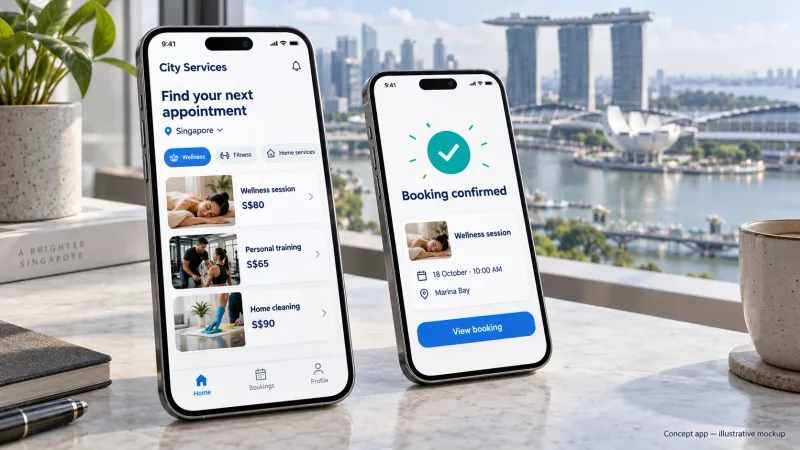
Developing an app for a company operating in Singapore starts with defining what its users need and how the product will connect with the business. A booking app, an employee tool, and a service platform each require different features, integrations, and maintenance approaches.
Before hiring a mobile app development company, it’s a good idea to define the scope of the first version: what tasks it will enable users to complete, whether it will be available for iOS and Android, what languages it will need, and what systems it will need to connect to. This information helps you request comparable proposals and identify decisions that may affect the budget or timeline.
Table of Contents
In this guide, we explain how to choose a partner to develop an app for the Singapore market, what your proposal should include, and how to prepare for the launch. You’ll also find criteria for deciding when to incorporate custom software, artificial intelligence, or automation, as well as a section dedicated to Aixo as a provider you can consider for your project.
What to Decide Before Hiring Someone to Develop an App
Prepare a brief document explaining the problem you want to solve, who will use the application, and what they need to do. You don't need to have all the screens designed yet, but you do need a foundation that allows vendors to assess the scope and identify any outstanding issues.
Share the same document with the companies you're evaluating. That way, you can see what each proposal includes and how their estimates differ.
Users, Target Audience, and Essential Features
Identify the user profiles that will use the app and the tasks each one will perform. In a booking app, for example, customers can check availability and confirm an appointment, while the business team needs to manage schedules, changes, and cancellations.
For each main route, describe:
- What action does the user take?.
- What information do you need?.
- What steps you need to take.
- What result do you hope to achieve?.
- What happens if there is an error or you cancel the process?.
Also define what outcome you're looking for for the business: making it easier to sign up for a service, reducing manual inquiries, or improving team coordination. That goal will help you prioritize features and evaluate the usefulness of the first version.
Platforms, Languages, and Launch Scope
Decide whether you need iOS, Android, or both platforms based on your target audience's devices and habits. If you don't have that information yet, include it as an issue to be addressed during the product definition phase.
For an app targeting Singapore, specify which languages your users need and who will prepare and review the content. Include screens, error messages, notifications, and communications related to the service.
Also distinguish between the initial market and potential expansion. If you plan to launch in other countries later, let us know so we can assess which elements can be shared and which will need to be adapted.
Add any usage requirements that affect development: specific devices, accessibility, offline operation, or internal distribution to employees.
Integrations and the First Version of the Product
List the tools that the application needs to connect to. These may include a reservation system, CRM, inventory management, payment processing, maps, or messaging services.
For each integration, explain what data will be exchanged, which system controls it, and who can provide documentation and access. If a connection has not yet been verified, it must remain pending validation before the quote is finalized.
Next, separate the essential features from future enhancements. In a booking app, the first version could focus on checking availability, making a reservation, receiving a confirmation, and managing a cancellation. A loyalty program or an AI-powered assistant can be considered at a later stage.
The result will be a requirements document that includes users, objectives, main user flows, platforms, languages, and integrations. With this document, you can request a proposal that explains what will be built and what needs to be addressed before starting.
What a Mobile App Development Proposal Should Include
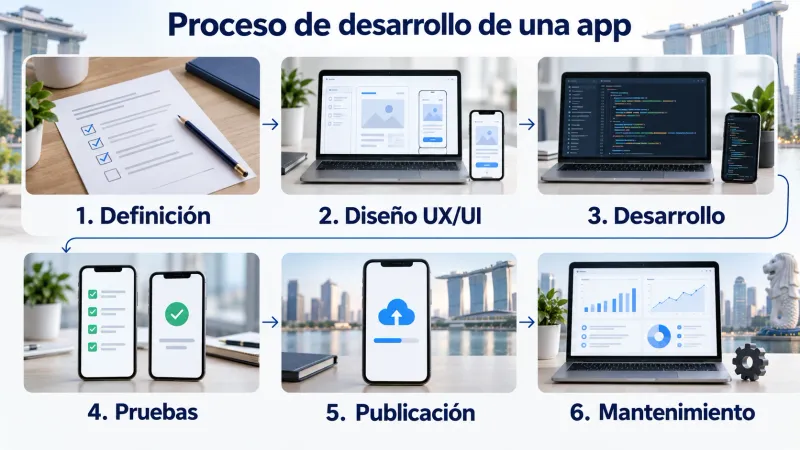
A proposal should explain how your app's requirements will be turned into a ready-to-use product. Review the deliverables, responsibilities, and acceptance criteria for each phase.
To compare quotes, make sure they cover the same scope of work. Design, backend development, integrations, or deployment may be included in one quote but billed separately in another.
Product Definition and UX/UI Design
The definition phase should specify the user flows, the features of the first version, and any pending decisions. Depending on the complexity of the project, it may include a proposed architecture and initial testing of the most important integrations.
For UX/UI design, please specify whether you will receive:
- Navigation Structure and Screens.
- Visual design of the application.
- Prototype for reviewing the main routes.
- Load statuses, errors, and missing information.
- Localizations into the agreed-upon languages and compliance with accessibility requirements.
For a booking app, for example, the prototype should allow users to see how a service is selected, availability is checked, and an appointment is confirmed. It should also include scenarios such as a time slot becoming unavailable or a payment not being completed.
Agree on the review rounds and the approval process. This will help you distinguish between planned adjustments and changes that expand the scope.
Mobile development, backend, and admin panel
The proposal must identify the iOS and Android versions, the recommended technology, and the reasons for that choice.
Also check what components the application needs to function: accounts, permissions, data storage, notifications, and connections to other systems. If part of this infrastructure already exists, determine what can be reused and what will need to be modified.
The administration panel must support the tasks of the team that will operate the service. It should allow users to manage reservations, update content, respond to requests, or review activity. Each function must be included in the scope.
For integrations, please identify the necessary third-party access and collaboration. The availability of an API or data preparation may affect the timeline.
You can check out our services at mobile application development to learn about the components and stages involved in creating a business app.
Testing, Publication, and Maintenance
Define what will be tested before launch and how each release will be approved. The tests should cover the main user flows, the intended devices, permissions, and integrations.
In a booking and payment app, it's a good idea to check for confirmations, cancellations, duplicate transactions, and connection errors. If the app supports multiple languages, also check the messages displayed on the screens.
For the release, clarify who will prepare the versions, accounts, and materials required by the App Store and Google Play. Agree on how to address feedback from the stores, whose review processes may affect the release date.
The proposal must specify the post-launch conditions:
- Correction of errors: coverage and agreed-upon period.
- Technical maintenance: updates and compatibility tasks.
- Support: channels, schedules, and response times.
- Development: Procedure for adding new features.
It also includes the source code, documentation, and the necessary access credentials. These elements will allow you to evaluate both the initial development and the conditions for operating and expanding the application.
React Native, Flutter, or Native Development: How to Choose
The choice of technology depends on what the application will do, the devices it will use, and how it will be maintained. The fact that the product is intended for Singapore does not, by itself, determine which technology is best to use.
Ask the vendor for a recommendation based on your requirements, including its advantages, limitations, and implications for future versions.
| Alternative | Approach | What You Should Verify |
|---|---|---|
| React Native | It allows code to be shared between iOS and Android and uses native UI components | Integration compatibility, specific components, and team expertise |
| Flutter | It allows code to be shared across platforms and uses its own interface system | Align with the design, device functions, and necessary dependencies |
| Native development | Use the native tools for each platform—typically Swift for iOS and Kotlin for Android | Specific requirements, performance, and resources needed to maintain both versions |
How to Integrate Technology with Your App's Features
For a booking app, a customer portal, or a management tool, it may be helpful to share some of the development work between iOS and Android. The amount of code that can be reused will depend on the features and the differences between the platforms.
If the app requires Bluetooth, sensors, multimedia processing, or integration with specific system features, request that its compatibility be evaluated. When in doubt, a technical test can help you make a decision before budgeting for the full development.
Offline operation also requires planning: what data will be available, how changes will be saved, and how potential conflicts will be resolved when the connection is restored.
What to Ask Before Accepting the Recommendation
Ask the supplier to specify:
- What requirements justify the proposed technology?.
- Which parts of the development will be shared across platforms?.
- What functions will specific components require?.
- Which external libraries and services will be used.
- How performance will be tested on the intended devices.
- How updates and maintenance will be handled.
A cross-platform solution still requires testing on iOS and Android. A native solution requires coordinating the development of both versions when the product is available on both platforms.
Evaluate the technical proposal along with the team's ability to maintain it. The decision should allow for the development of the necessary features and the evolution of the application at a reasonable cost.
How to Prepare an Application to Operate in Singapore
Developing an app for Singapore requires determining who will use it, how users will purchase or receive the service, and what systems the business needs to manage it. These decisions must be reflected in the design, integrations, and testing.
Distinguish between the requirements for the initial launch and those that may arise as you expand into other countries in Southeast Asia. This will allow you to define the scope of the first version and anticipate future adaptations.
Languages and User Experience
Select the languages based on the target audience and the context of use. The language used in development meetings does not determine which versions the application needs.
Include screen text, forms, notifications, error messages, and help text in your planning. Determine who will prepare the translations and who will review them within the product.
Make sure users understand the main actions: signing up, viewing a service, making a reservation, paying, or requesting assistance. If the app uses business-specific terms, verify that they are clear to your audience.
Also, design the interface to accommodate text of varying lengths, and determine what will happen when content is not available in the selected language.
Currency, hours, and formats
Define how amounts, dates, times, phone numbers, and addresses will be displayed. Make sure the forms accept the information your users need to provide and that the messages explain how to correct any errors.
In a booking app, specify which time zone determines availability and how an appointment will be displayed to a user accessing the app from another country. Reminders and confirmations should use the same criteria.
If payments are involved, make a clear distinction between the currency displayed and the currency used for billing. Before confirmation, explain the total amount, the items included, and the terms of service.
When you plan to operate in multiple markets, identify which settings will depend on the country, the account, or a user's choice.
Payments and Required Integrations
Choose payment services based on your business needs and verify their availability for the entity that will contract the service, the users, and the planned transactions.
Before finalizing the scope, check with each vendor:
- Accepted payment methods and currencies.
- Admission requirements and required documentation.
- Fees and other usage costs.
- Support for one-time or recurring payments.
- Cancellation and Refund Management.
- Test environments and technical documentation.
It also defines how payments will be linked to reservations, orders, or subscriptions. An interrupted transaction should not leave the user unsure whether they have paid or whether the service has been confirmed.
Apply the same review to connections with CRM, inventory, messaging, and other tools. Clarify which system controls each piece of data and how synchronization errors will be handled.
Pre-launch validation
Test the main user flows with members of the target audience. Ask them to complete specific tasks and observe where confusion, errors, or drop-offs occur.
In a services app, you can check whether users find what they need, understand the price, complete a reservation, and know how to modify it. Also review the messages they receive after each action.
Includes the devices, languages, and integrations planned for launch. Testing should account for scenarios such as loss of connection, declined payments, or changes in availability.
Record issues, prioritize their impact, and verify fixes before rolling them out more widely. If you later launch in other markets, validate those adaptations separately.
The result of this preparation will be a set of verifiable decisions regarding languages, formats, payments, integrations, and acceptance criteria for the first version.
How to Compare App Development Companies
Comparing vendors requires reviewing what each one offers for the same project. Share a common requirements document and request proposals that clearly outline deliverables, exclusions, and outstanding issues.
For an app targeting Singapore, also verify who will validate the product adaptations and necessary integrations. These responsibilities should be reflected in the scope.
Similar projects and verifiable references
Ask for examples related to your app's features. A booking and payment app presents different challenges than an employee tool or a content platform.
Ask what part of the work the vendor completed and what you can look into to assess their experience:
- Published applications or demonstrations.
- Explanations of the features developed.
- Technical decisions and challenges overcome.
- Client references, when available.
- Maintenance work and subsequent developments.
Distinguish between completed projects and prototypes and conceptual examples. If there are confidentiality restrictions, ask for an explanation of the team’s work without revealing sensitive information.
The most useful references describe how deliveries, changes, and issues were handled. Use them to compare the supplier's proposed approach to work.
Scope, Budget, and Monitoring
Review the proposals by phase: definition, design, mobile development, backend, integrations, testing, and release. Verify that all of them include the essential features needed for launch.
Request that the assumptions affecting the price be documented. For example, an estimate may depend on receiving approved content, having a functional API, or reusing existing infrastructure.
Before making a decision, clarify:
- How the budget is calculated and what type of contract is proposed.
- What milestones are associated with payments?.
- How changes to the scope will be approved.
- Which tasks are the responsibility of your company or third parties?.
- How you will review and approve each submission.
- Which departments can modify the calendar?.
Ask for details on the follow-up process: who will be in charge of the project, how often progress demonstrations will take place, and access to a testing environment. If the team is working in a different time zone, agree on available times to review progress and address questions.
Code Ownership, Access, and Support
Agree in writing on the ownership of the developed code and the terms of use for external components. Identify any dependencies and licenses that may affect maintenance.
Define who will manage the repositories, infrastructure, publishing accounts, and third-party services. Specify what access your company will receive and when.
It includes documentation for configuring, deploying, and maintaining the product. If another team takes over the work in the future, that information will facilitate the transition.
To compare support options, ask for details on:
- Channels and hours of operation.
- Incident Classification and Response Times.
- Bug fixes and technical maintenance.
- Updates included.
- Budget for new features.
- Handoff and transfer of service to another team.
Compile the responses in a table using the same criteria for all vendors. This will allow you to evaluate experience, scope, and service continuity along with price.
Local Supplier or Remote Partner: How to Organize Collaboration
When hiring an app development team for a company based in Singapore, consider where the work needs to be done and how your team will be involved. A physical presence may be important for observing processes, testing equipment on-site, or holding sessions with users.
Other activities can be conducted remotely using documentation, prototypes, demonstrations, and test environments. Determine which ones require in-person participation and who will be responsible for them before comparing vendors.
Communication, Schedules, and Contact Persons
Agree on the language to be used in meetings and documentation. The people reviewing the product must be able to understand the requirements, resolve questions, and approve decisions.
If the vendor operates in a different time zone, specify the overlapping hours and how inquiries will be handled outside of those hours. Distinguish between follow-up meetings and post-launch support coverage.
It also identifies two responsibilities:
- Product Manager at your company: sets priorities, coordinates reviews, and addresses business questions.
- Project Manager at the vendor: It organizes the work, communicates with departments, and tracks deliveries.
Document decisions that affect the scope, budget, or timeline. This allows both parties to work from a shared reference point.
Reviewing Deliverables and Preparing for Launch
Request regular demonstrations of features that you can test. Access to a testing environment will allow your team to review user flows and log issues during development.
For each session, agree on what will be evaluated, who will participate, and how much time will be allotted for responses. If you need users or operational staff in Singapore, plan for their availability.
Before the launch, confirm who will conduct the final tests, prepare content and accounts, and coordinate the go-live. Also define how issues will be reported and who will decide on urgent fixes.
Finally, check where the team works, which company you’ll hire, and what availability it offers. Providing services to companies in Singapore and having an office there are two different things; understanding these differences will help you evaluate the collaboration model.
Aixo: An Option for Evaluating Your App Project in Singapore
If you're looking for a partner for an app targeting the Singapore market, you can check out Aixo and outline the requirements for your project.
To assess whether we're a good fit, please let us know who will be using the app, what features the first version needs, and which systems it will need to connect to. Also indicate whether you're looking for development for iOS, Android, or both platforms.
Request a proposal that specifies:
- The scope of the app's design and development.
- The recommended technology and the rationale for it.
- The backend, the admin panel, and the integrations.
- Responsibilities regarding testing and publication.
- Deliverables, the schedule, and maintenance terms.
Compare that information with the criteria in this guide and ask for examples relevant to the features you need. If the project involves additional software, AI, or automation, check their availability and scope so you can evaluate them alongside the mobile app.
Software, AI, and automation tools that complement an app
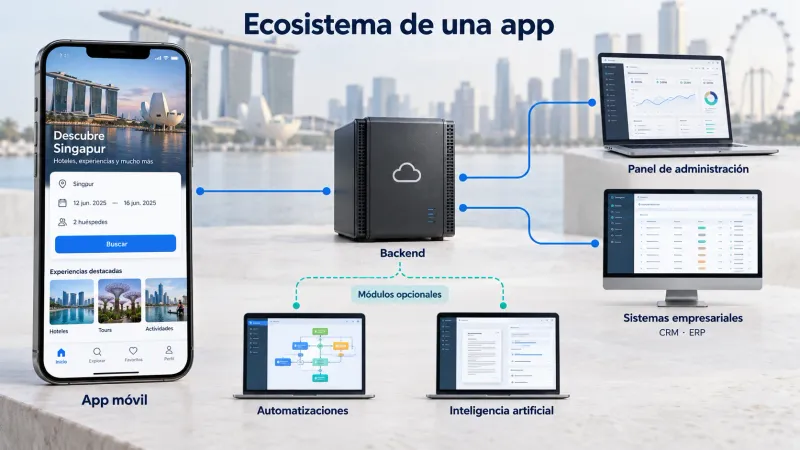
A mobile app may require additional tools and processes to provide a complete service. A reservation made from a phone, for example, can update the business's calendar, create a task, and send a confirmation.
Define these components along with the app's main user flows. This will help you identify what the first version needs and what improvements can be added later.
Custom Software and Business Systems
If your company already uses tools to manage customers, reservations, orders, or inventory, find out how the app will integrate with them.
Before building an additional system, check which functions can be handled using existing tools. If there are needs that these tools do not meet, it may be necessary to develop a dashboard, a portal, or specific software.
For each connection, define:
- What information will the systems exchange?.
- Which tool manages each piece of data?.
- Which users will be able to view or edit it.
- When will the information be updated?.
- How errors and duplicate data will be handled.
In a booking app, for example, the availability displayed must match the availability used by the business team. This coordination must be taken into account during development and testing.
You can check out our services at custom software development to learn how we approach tools tailored to business processes.
Process Automation
Automations allow you to perform actions when an event occurs and certain conditions are met.
A confirmed reservation can trigger a reminder; a prepared order can send a notification; a pending request can generate a task for the responsible team.
Before implementing each process, specify what triggers it, what actions it can perform, and how its results will be verified. Also include what will happen if a connection fails or if the same event is received multiple times.
Processes with clear conditions can be handled using rules. These rules define when a person should intervene, especially in cases of exceptions that affect the service provided to the user.
Artificial Intelligence for Specific Functions
AI can complement an app in tasks such as looking up information, extracting data from documents, or preparing responses for review.
Each role must address a specific need and have evaluation criteria. If an assistant answers questions about a service, for example, it is important to verify that they use up-to-date information and that they recognize when they cannot provide an answer.
Also define the data to which the user will have access, the permissions, and the actions that require approval. Plan what the user will see when the result is invalid or the service is unavailable.
When budgeting for these functions, be sure to factor in integration, testing, the use of external services, and maintenance. For more information, please visit our artificial intelligence development services.
Prioritize the components that best enable users to complete the app's main workflow. Software, automations, and AI should be incorporated with a defined scope and a way to verify their usefulness.
How much does it cost to develop an app in Singapore, and what factors affect the timeline?
To prepare a budget for an app targeting Singapore, you need a financial benchmark and a clearly defined scope. Features, the backend, integrations, and testing can lead to significant differences between projects that appear similar.
Approximate Price Ranges for App Development in Singapore
According to a report published by a local vendor, SwagSoft's 2025 guide estimates that a simple app or MVP costs between 30,000 to 70,000 SGD, an application of intermediate complexity between 70,000 to 150,000 SGD and a complex business project starting from 150,000 SGD.
| Level of complexity | Published Estimated Range |
|---|---|
| A simple app or MVP with a limited scope | 30,000–70,000 SGD |
| App of intermediate complexity | 70,000–150,000 SGD |
| Complex business app | Starting at 150,000 SGD |
These are quotes from that provider; they are not a statistical average for the market or an Aixo rate. Check what each offer includes and what costs are not covered. Source: SwagSoft Budget Guide.
How the Budget Varies Depending on the Type of Application
The sector provides context, but the functions and terms of use determine the nature of the work. A simple information app and an operational platform may belong to the same sector yet require different levels of investment.
| App type or industry | Possible initial scope | Features That Can Increase the Cost |
|---|---|---|
| Reservations and Services | Check availability, make a reservation, and receive confirmations | Payments, Cancellations, Multiple Locations, and Schedule Rules |
| Retail and Distribution | Catalog, Customer Accounts, and Purchase Orders | Synchronized inventory, customer-specific rates, payments, and ERP integration |
| Logistics and Fieldwork | Tasks, statuses, and photo log | Offline use, geolocation, signatures, and complex synchronization |
| Internal Tools | Forms, Inquiries, and Process Tracking | Advanced permissions, data migration, and integration with existing systems |
| Subscription platforms | Registration and Access to a Service | Recurring Billing, Organization Management, and Permissions |
| AI Apps | A specific query or processing function | Data Preparation, Evaluation, Quality Checks, and Model Usage |
This table outlines scope factors; it does not assign a fixed price to each sector. A booking app can be a limited MVP or a complex system, depending on its rules, integrations, and management tools.
To get an estimate, please also specify whether you need iOS and Android, UX/UI design, backend development, an admin panel, and publishing capabilities.
What Factors Affect the Development Timeline?
The timeline should include the definition, design, development, testing, and preparation for launch. It also depends on approvals and resources provided by your company or a third party.
Before accepting a date, ask:
- What deliverables will you be able to review during the project?.
- When content, translations, and access should be available.
- Which integrations need to be checked.
- How will scope changes be managed?.
- How much time is set aside for tests and corrections?.
- How feedback from app stores will be addressed.
If there is uncertainty, an initial analysis phase can help define the scope before committing to the full development.
Ongoing Costs After Launch
Distinguish between the initial investment and operating expenses: infrastructure, external services, support, and updates.
Request an estimate of these costs based on usage scenarios. Messaging, maps, document processing, or AI can generate costs that vary depending on activity.
Also check the budget currency, applicable taxes, and whether maintenance is contracted separately. New features should be distinguished from the tasks required to keep the app operational.
Check out the Aixo cost guide
You can find more details about these criteria at the Aixo's Guide to App Development Costs in Singapore.
The guide explains which components are included in the budget and what to look for when comparing proposals. Use it to prepare for your consultation by defining your objectives, target users, platforms, features, and integrations.
With this information, you can request an estimate for your project and see what it includes, what depends on pending decisions, and what expenses you'll have after launch.
Frequently Asked Questions About App Development for Singapore
Do I need a vendor with an office in Singapore?
It depends on the project's activities. If you need frequent on-site work or in-person testing, consider how those tasks will be handled. For remote collaboration, agree on the language, schedules, responsible parties, and review of deliverables. Also confirm which entity you will hire and where the team is based.
In which languages should the app be available?
Choose the languages based on the users the product is intended for. Validate that decision with customers or employees from the target audience, and consider screens, notifications, and help. The language used to communicate with the vendor may be different from the one required by the application.
Can I launch in Singapore and then expand to other markets?
Yes. Determine from the outset which countries you might include to analyze translations, currencies, time zones, and integrations. Before each launch, check the availability of external services and validate the adaptations with users in the relevant market.
Should I develop for iOS and Android from the start?
It depends on your users' devices and the scope of the first version. If you need both platforms, ask for a comparison between cross-platform and native development. If you're starting with just one, ask for an explanation of what work will be required to incorporate the second one.
What information do I need to request a quote?
Prepare a summary that includes the objective, target users, essential features, platforms, languages, and integrations. Add your desired timeline and an investment range, if you have one. Specify what you expect the service to include: design, backend, administration, testing, deployment, and maintenance.
How to Start Your Mobile App Project
Write a summary describing the problem you want to solve, who will use the app, and what features the first version needs. Include the platforms, languages, and systems it will need to connect to.
If there are still pending decisions, include them in the consultation. The first step might be to explore an integration, define the scope, or validate a prototype before budgeting for the full development.
If your company operates in Singapore and you are evaluating suppliers, you can Submit your project to Aixo. Request a proposal that specifies the responsibilities, deliverables, timeline, and maintenance terms.
Compare that proposal with your requirements and your available budget. That way, you can decide on the next step in creating and launching your mobile app.